Blog
Distinguished visitor interactions and milestones from the QuIC Lab at RRI
Distinguished visitor interactions and milestones from the QuIC Lab at RRI
Pioneer in the field of quantum communication and quantum computation. Professor of Quantum Physics at the Mathematical Institute; Director, Centre for Quantum Technologies; Lee Kong Chian Centennial Professor — National University of Singapore.
Over the years we have had many distinguished visitors to the QuIC Lab at RRI. Here is a candid conversation with Prof. Ekert on the future of quantum computing, cryptography, and what a national quantum mission should prioritise.
What is the future of quantum computing? I am asking from a dual-hat perspective: one as a researcher in this field and another as a drafting committee member of the National Mission for Quantum Technologies and Applications (NMQTA) in India.
On a humorous note, when journalists ask me, will you see a quantum computer in your lifetime, I always ask them in return, are you referring to the progress in technology or state of my health! The way I see and understand, at the moment there is lots of hype about quantum computing and it has become a fashionable topic. There is Google, IBM, and every single month there are some other announcements of few more qubits. I think the public perception is that this is just around the corner and something will happen. However, people don’t realize that if you have 50 qubits or so and they are very noisy, it is difficult to see anything sensible but noise with them in an experiment. We need some breakthrough manipulation technique which can manipulate those qubits with high precision, high fidelity. With superconducting qubits you can do more, and you have a situation that ion traps have fewer qubits but better quality qubits, while people in superconducting business have more qubits but they are more noisy. This period of 5–10 years will be there with us before we get something better. So I would say it will probably be not before 10 but not after 50 years — a safe prediction — that we will see a real convincing experiment of the type such as factoring numbers that the classical computer cannot crack.
That’s a good quote because then we may not be living.
Exactly, I may not be living to be asked this question again. And then what is it good for? With intelligent guessing you can talk about optimization methods, pattern recognition, security aspects and other tasks that challenge a classical computer. Such tasks can be delegated to a quantum processor. You can even talk about artificial intelligence and machine learning — that’s all possible. If you take the progress in classical computer technology, imagine that you go back to the 19th century and you talk to Charles Babbage who just came up with an analytical engine and ask what is it good for? Would he ever think about the internet, movies, word-processors, Instagram, emails? Probably not! So I believe the future generation will build something very interesting based on the existing tools that we cannot perceive at the present moment. At the moment, the present generation will build tools and hand them over to the next generation who will improve those tools and start programming them seriously. In a way we are preparing the ground.
We are preparing the foundations.
We are preparing the foundations, exactly.
A related thing to discuss — we have classical computers and quantum computers and we don’t know when exactly quantum computers will actually come into practice. Do you think we will have something in transition, something like a bit classical and quantum?
Well, in terms of technology, obviously it is going to be a hybrid. It is not going to be a pure quantum thing that you will put on your desk. Most likely, one path will be a classical computer connecting to a cloud-based quantum computer in early stages. Soon after you will have a quantum processor in your laptop dealing with certain routines that are difficult for classical computation. I don’t think it will ever be completely quantum as we may think about it. Typically a quantum processor will be embedded within a classical system — that’s from the technology point of view and that’s how I see it.
Related to quantum cryptography, what is its contextual relevance in current times?
The value of quantum cryptography goes together with the value of the progress in building a quantum computer. Because we do know that quantum computers can certainly break existing classical cryptographic protocols — RSA, elliptic curves — which are based on hardness of factoring, discrete logarithm. Then the answer is either quantum crypto — immune to quantum attacks — or post-quantum crypto, where you find mathematical problems useful for cryptography that are immune to quantum attacks. Quantum crypto is good but has limitations. It is ideal for point-to-point communication. There is a lot of interesting work going on in the crypto community. NSA has announced an open call for next-generation cryptographic standards immune to quantum attack. We have to work in two directions: (1) develop quantum cryptographic protocols and (2) build mathematical tools to make cryptography resilient to quantum attacks. They are complementary.
Would you agree that quantum cryptography, at least from the experimental point of view, is more mature than quantum computing?
Oh yeah, of course it is much more mature. Quantum cryptographic devices are even commercially available. You can obviously buy quantum cryptosystems today. The next generation is device-independent quantum crypto, which would need improvements in the quality of the source and detectors. But it is certainly nothing compared to the difficulty one would have to face to build a quantum computer.
What are the interesting problems in the fundamental aspects of quantum information we should be looking at?
The impact of quantum information science goes beyond practical applications. It revises our notion of computation — people realize that the theory of computation is really a part of physics rather than mathematics, because what can be computed depends on the underlying physics. There is a lot of interest in the community of quantum gravity to see how entanglement can underlie certain features of space-time. To be honest, my preferred scenario is that this quantum computer cannot be built for a good reason. If it is discovered that the quantum computer cannot be built, then this would be the best-case scenario — physicists would be jumping up and down, and you would learn something more profound about nature.
What about the funding agencies, then?
Actually, then you can promise them something even more powerful — you incorporate this new phenomenon. Like if you move from classical to quantum, you build a quantum computer as more powerful. Suppose you discover something — call it post-quantum or beyond quantum — you allow a proper understanding of phenomena that can help you develop an even more powerful device. Then you can go to the funding agency and say, “forget about quantum computers, it’s now passé. Now we are building BQC: beyond quantum computers.”
Beyond quantum.
Yes — beyond quantum theory. Building quantum computers will be building the most sophisticated device ever built by mankind. This will actually push the boundaries of playing with quantum physics and testing quantum theory to its limits. That constitutes the most complex multiparticle quantum interference experiment ever made by people on this planet.
What do you think a national mission should concentrate on?
I think the mission should boldly go where no one has gone before, while promising the practicalities with modesty. Concentrate on the development of quantum crypto devices, simulators, repeaters, memories, quantum computers for pattern recognition or maybe for crypto purposes at some point. However, while doing so, at every single step when you make the system more complex and every time you check where it can go wrong — every time it goes wrong, you feel happier: bingo, now we are moving to BQC.
You better credit me for this term.
I just made a statement now officially that I do not claim the ownership of the term. I would personally mention your name when I write BQC: beyond quantum computing.
With that — what is the impression from your visit about our lab activities, our stuff at RRI?
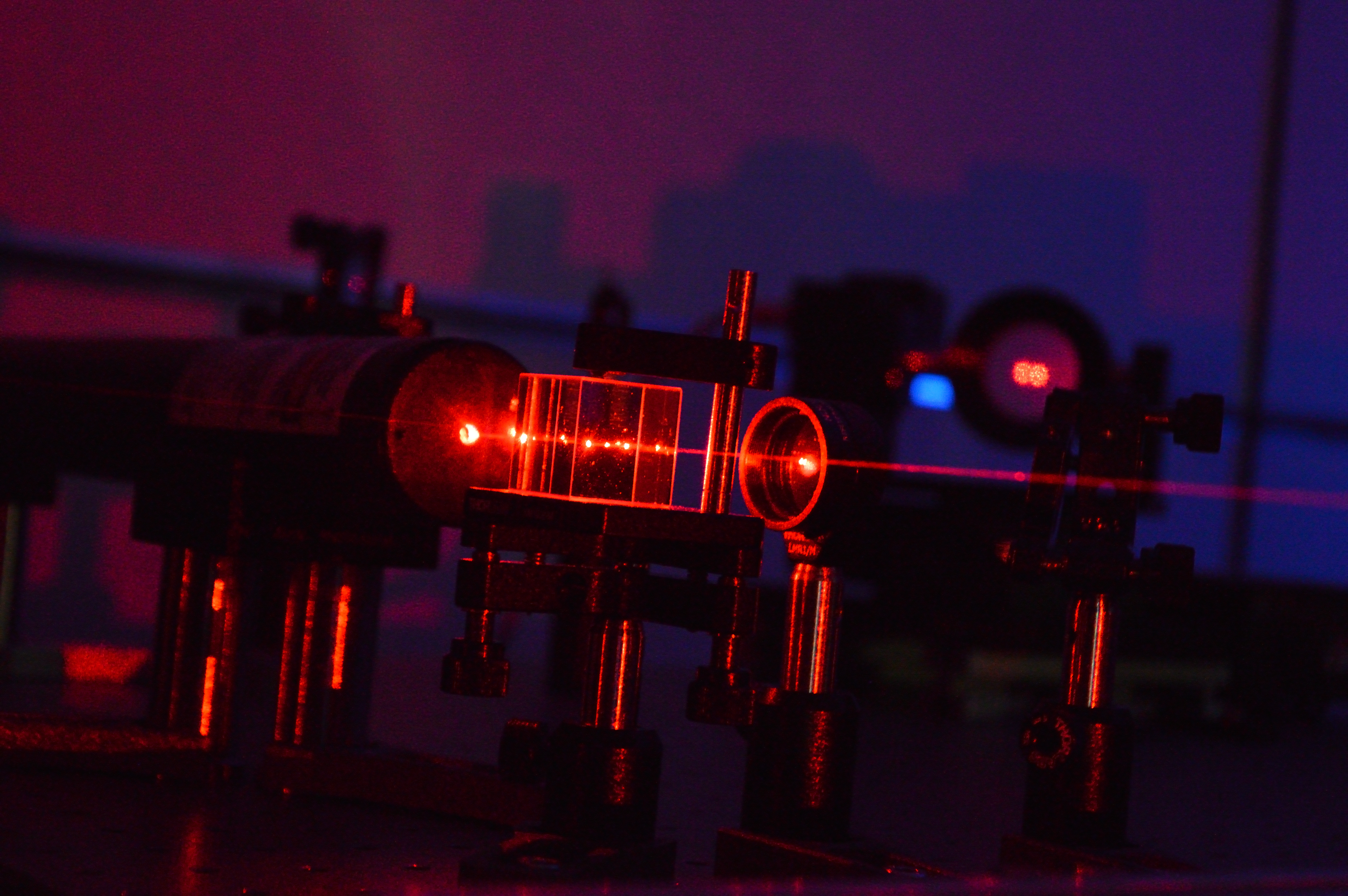
Usually it is customary to say good words, but I think I didn’t expect this to start with my first visit. As from my previous visits to other places in India, I didn’t see any experimental groups in this field, and yours is exceptional. Going to your lab it could be anywhere in Oxford, Cambridge, MIT, Singapore — the optical tables around the world look pretty isomorphic. But when you speak to the guys, you immediately see how they present something, how they go to the essential details, they are pretty confident and proud about what they are doing and also are having fun. In that note, I think you have one of the best labs!
Ten years of the QuIC Lab — messages and wishes from our beloved past members, looking back at the experiments, the late nights, the eureka moments, and the friendships that made the lab what it is.
This is truly music to my ears that we are celebrating the 10th anniversary of the QuIC lab. Time flies, but not memories! Congratulations to all the current and previous lab members and especially you as PI of the QuIC lab, which has achieved several feats in all these years and has established itself as one of the preeminent labs in photonic QIP. My journey at RRI and QuIC lab as a Ph.D. student has been truly amazing and has contributed significantly to my career growth. May you all achieve the sweetest dream of your life and fulfill your aspirations.
Congratulations to you and all the past and existing lab members for achieving this milestone. I feel proud to be a part of QuIC lab, which has been one of the leading research facilities working in the field of ‘anything quantum’. I feel privileged to have worked on various exciting quantum experiments during my Ph.D. tenure. I also cherish the memories with all my labmates, who are both exceptional scientists and extraordinary friends. May the force be with you.
“The RRI – QuIC research environment and consequent interactions with my peers and advisor provided me with a toolbox of different skills that has paid dividends in my research career and professional relationships.” QuIC lab, I truly wish you all my best wishes and love, and thank you so much for the opportunity to be a part of it.
QUIC lab: the name which is always very close to my heart. This is partly because when I first saw her she was just born and then I experienced her day by day while she was growing! But mostly because, it gave me the opportunity to learn new things, to face unseen challenges, to acquire the knowledge of both optics and quantum mechanics, to work in a group, to be patient, to not lose hope, to celebrate the success!
And how time flies — today, 10 years have passed! I still remember those days when we used to level the cupboard, organize the stuff we purchased, and learnt how to deal with the Ti-Saph laser. I can see that day when we first saw the single photons, succeeded in coupling photons into the fibre and observed the coincidence peak.
Days passed when we did not achieve the Hong–Ou–Mandel dip, and then one evening — I still cherish that moment — we observed the famous dip! And ma’am was there, always, while building it up with all her efforts, providing us all the resources we needed, and giving us the care and support when we needed that most. I truly admire the spirit that was never about ‘I’ but about ‘We’, be it a moment of failure or success.
There were tea breaks, there were pizza parties, there were birthdays with cake, there were enthusiastic visitors, conferences, new experiments, challenges, thrills, despair, and then also hope and joy. I really wish I could taste all those flavours once more. QUIC lab, I truly wish you all my best wishes and love.