The security of modern classical cryptography rests on the computational hardness of certain mathematical problems — an assumption that will be undermined by quantum computers. QKD offers an alternative: a key-exchange scheme whose security is rooted in fundamental quantum principles and is therefore immune to any increase in computational power.
The success of QKD rests on the following three principles :
Public-key cryptographic schemes (such as RSA) are vulnerable to efficient quantum algorithms — Shor's algorithm can perform integer factorization in polynomial time, breaking RSA entirely. Private-key schemes are safer if the key is long enough, but distributing such keys securely over an open channel has always been the bottleneck. QKD solves this key-distribution problem unconditionally: any attempt by an eavesdropper to intercept the quantum channel introduces detectable disturbances, so Alice and Bob can always tell if their key has been compromised.
Proposed by Bennett and Brassard in 1984, BB84 is the first and most widely studied QKD protocol. It encodes key bits in the polarisation states of single photons across two mutually unbiased bases (rectilinear and diagonal). After transmission, Alice and Bob publicly compare the bases they used — keeping only bits where their choices matched (sifting). Any eavesdropping introduces errors in the sifted key, quantified as the Quantum Bit Error Rate (QBER). If the QBER is below 25%, a secure key can be distilled; otherwise the protocol is aborted.
Our lab investigates performance optimisation of such protocols — including a patented method (Indian Patent No. 587808) for improving QKD system performance under realistic channel conditions.
In 1992, Charles Bennett proposed the B92 protocol in his paper “Quantum cryptography using any two non-orthogonal states.” B92 is a modified version of the BB84 protocol; the key difference is that while BB84 uses four polarization states of a photon, B92 uses only two — one from the rectilinear basis (conventionally the H-polarization state) and one from the diagonal basis (conventionally the +45° polarization state). The protocol can be summarised in the following steps:
Alice sends a string of photons in either the H-polarisation state or the +45° polarisation state, chosen randomly. The H-state corresponds to bit ‘0’, while the +45° state corresponds to bit ‘1’.
Bob randomly chooses between the rectilinear and diagonal bases to measure the polarisation of the received photon.
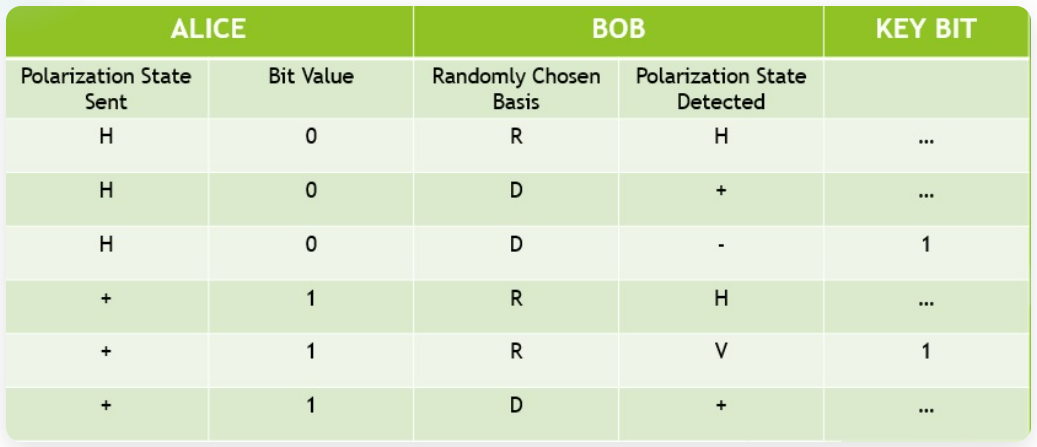
If Bob measures in the rectilinear basis, two cases arise: an H-polarised photon yields the H-state with probability 1, whereas a +45° photon yields either the H-state or the V-state with probability 0.5. Thus, only a V-state outcome lets Bob confidently infer the incident photon was ‘+45°’.
By the same argument in the diagonal basis, a −45° outcome indicates the incident photon was ‘H’.
After transmission, Bob announces the instances where the outcome was ‘V’ or ‘−45°’; the rest are discarded by both parties. These results are used to generate a random bit string shared by Alice and Bob.
To check for eavesdropping, Alice and Bob publicly share part of the generated string. If the error exceeds a tolerable limit, the protocol is aborted; otherwise they have established a secure, symmetric key.
Another important contrast with BB84 is that Bob does not have to announce his basis choice in the post-transmission communication — i.e. sifting is not required. The table 1 shows the possible transmission and measurement outcomes.