Quantum communication harnesses the laws of quantum mechanics to transmit information with provable security — a guarantee that no classical cryptographic scheme can offer. Our lab develops quantum communication protocols using single and entangled photon sources produced via spontaneous parametric down-conversion, targeting practical deployment over both fibre and free-space optical links.
A central focus is Quantum Key Distribution (QKD): enabling two remote parties to establish a shared secret key whose security is guaranteed by physics rather than computational hardness. We investigate QKD protocols both theoretically and experimentally, and have developed optimized QKD systems, including patented methods for improving QKD protocol performance.
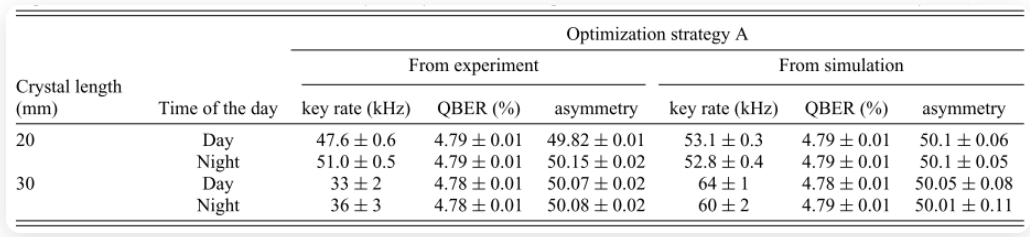
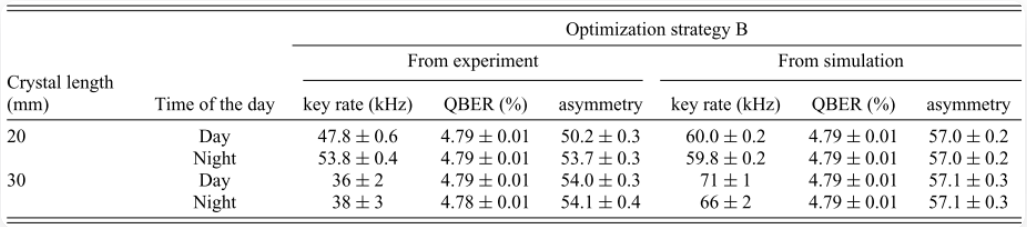
With a transmission channel length of ~2 metres, pump power of 30 mW, and crystal lengths of 20/30 mm, we obtained the following experimental and simulation results presented in Table 1
In our BBM92 protocol implementation, we use polarization-entangled photon pairs that produce the entangled (singlet) state:
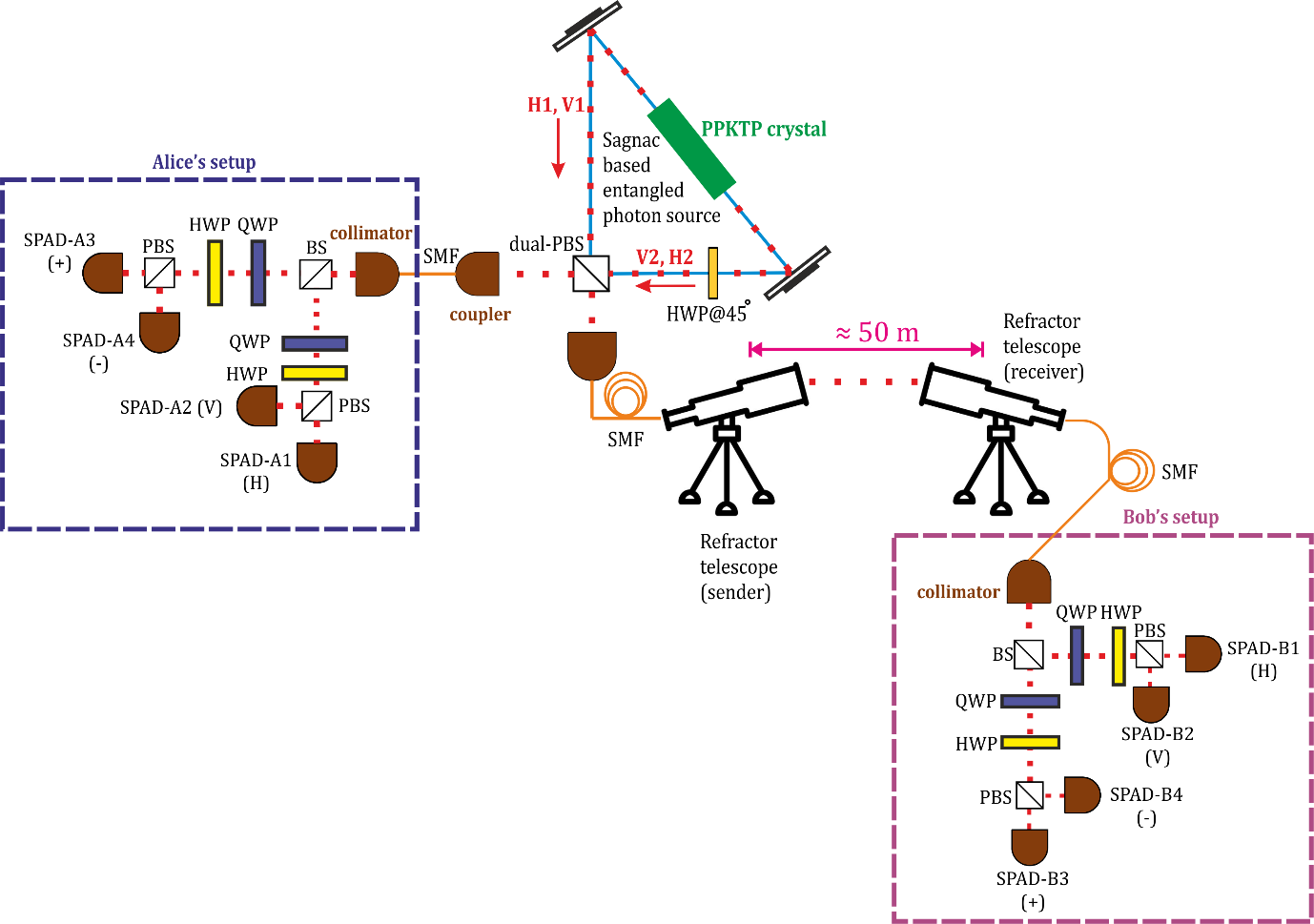
Alice (1) and Bob (2) both measure the stream of incoming photons — say, horizontally polarized (H) and vertically polarized (V), or vice versa. Photons entering Alice’s and Bob’s setups are randomly segregated for measurement along the two rectilinear or diagonal projection bases with 50:50 probability by a beam-splitter. The schematic of our experimental setup is shown below. The free-space (atmospheric) channel length from the sender (source / Alice’s setup) to the receiver (Bob’s setup) is ≅50 metres. Each basis projection can lead to either of two outcomes (detection along the transmitted arm: H or diagonal D/+ polarized; or along the reflected arm: V or anti-diagonal A polarized photon of the polarizing beam-splitter). Hence we obtain eight coincidence detections between Alice’s and Bob’s detector clicks. Four of them (A1–B2, A2–B1, A3–B4, A4–B3) form the desirable set (signal: HV/VH, DA/AD) and the other four (A1–B1, A2–B2, A3–B3, A4–B4) form the undesirable set (noise: HH/VV, DD/AA). We assess the coincidences in these sets by analysing the signal-to-noise ratios (SNRs) through suitable window spans around the peak maxima. The signal and noise values obtained within these windows are then used to compute the raw key rate, the quantum bit error rate (QBER), and the key symmetry of our implementation. Our first measurements in February 2021 achieved a reasonably good key rate together with an information-theoretically secure QBER. This was India’s first demonstration of QKD over an atmospheric free-space channel, as part of India’s first project on satellite-based quantum communications — “Quantum Experiments using Satellite Technology” — a collaboration between the QuIC Lab at RRI and the Indian Space Research Organisation.
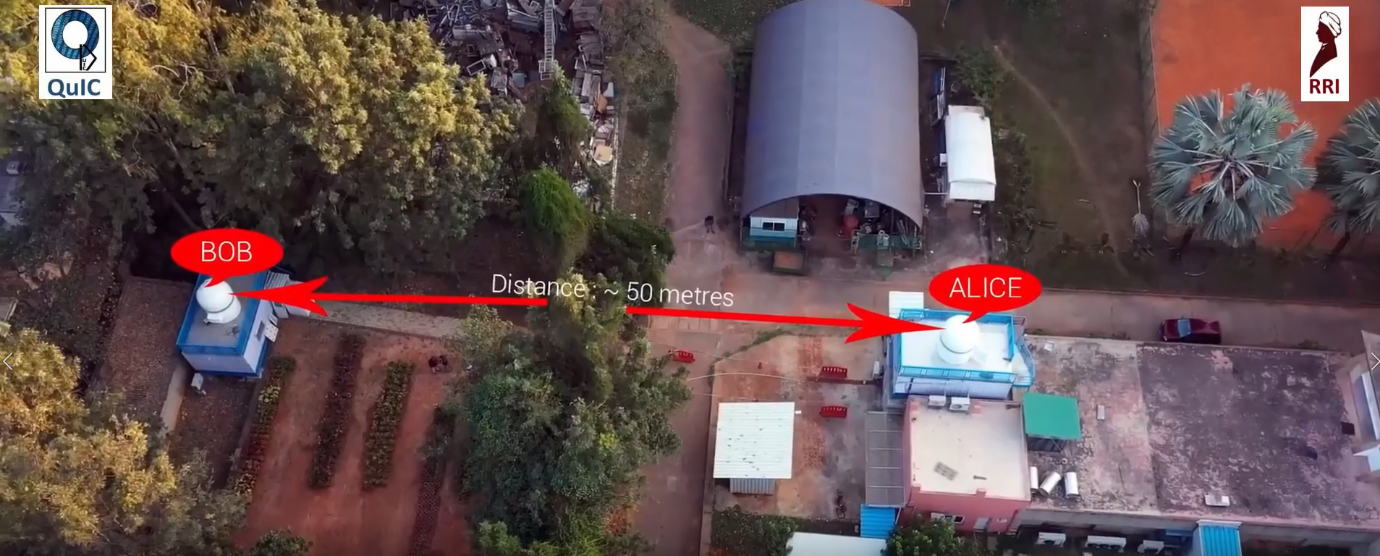
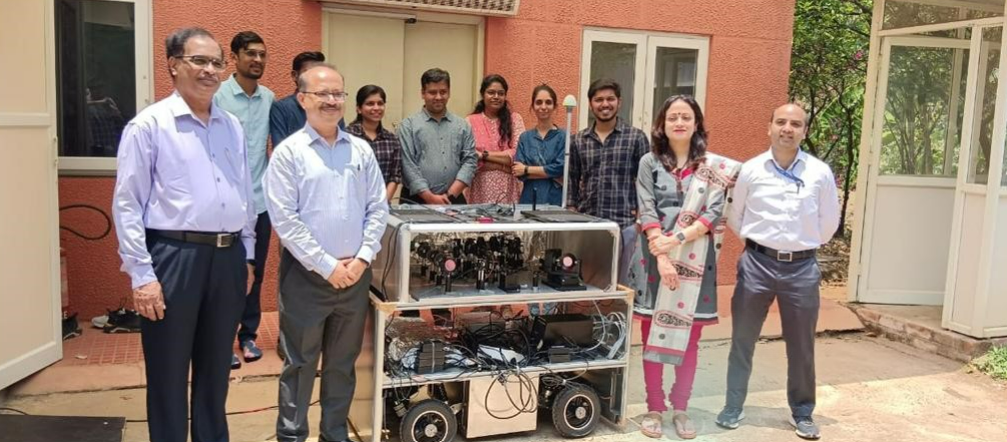
In March–April 2023, the QuIC Lab at the Raman Research Institute demonstrated the first Indian prototype for Quantum Key Distribution (QKD) with a moving receiver platform. This demonstration of entanglement-based secure quantum communication through an atmospheric free-space channel — between a stationary source and a moving receiver — received wide media attention and appreciation.
While the entangled-photon source remains within the lab, one photon from the entangled pair is sent to Alice (on another optical table in the lab) and the other to Bob, placed on a moving platform outside the lab, through a fibre channel followed by gimbal setups and the free-space channel. We use the BBM92 QKD protocol, which uses entanglement as the quantum correlation between distant photons to share secure keys between Alice and Bob.
The moving platform was designed, built, and assembled within RRI through the collaborative efforts of researchers and engineers at the QuIC Lab and a team from the RRI mechanical workshop. The vehicle accommodates all the optics required for Bob’s measurement module, carefully isolated single-photon detectors, a time-tagger unit, a GPS antenna with controller, motorized gimbals and stages with their controllers, and batteries with the electronics needed for the vehicle’s automation.
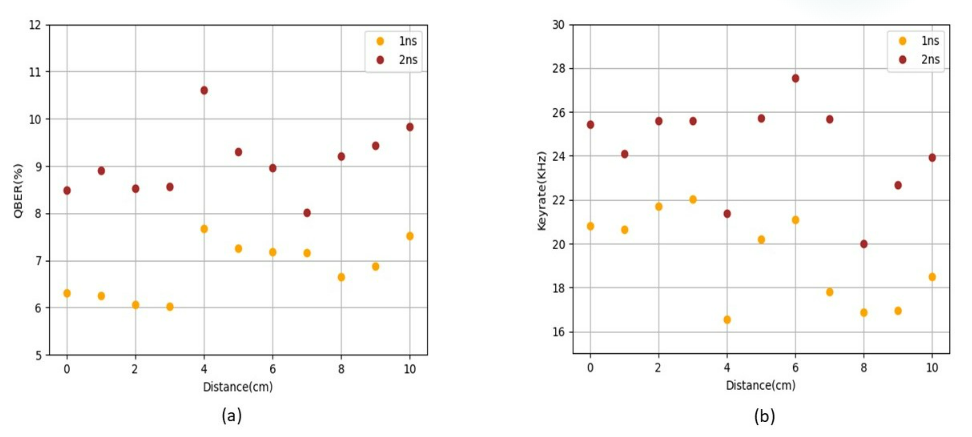
Our demonstration involved several iterations of the QKD protocol. When a receiver moves it becomes very tricky to maintain the line of sight between sender and receiver; a system is needed to keep pointing the laser beam towards the receiver from the source for optimal single-photon detection. Hence we developed our own Pointing, Acquisition and Tracking (PAT) system. Initially we used our PAT algorithm to correct for the changed line of sight in a start-and-stop condition of the vehicle. The figures below show representative data from those runs.
Currently, we perform continuous correction as the vehicle moves and successfully acquire data. We call this Payload 1.0 — an ongoing effort towards realizing the final payload for uplink-based satellite QKD under the QuEST project, in collaboration with the Indian Space Research Organisation (ISRO).