An NV center is a point defect in the diamond crystal lattice, formed when a substitutional nitrogen atom sits directly adjacent to a carbon vacancy (a missing carbon atom) along one of the four ⟨111⟩ crystallographic directions. This gives the defect a characteristic C₃ᵥ symmetry — the nitrogen atom and the vacancy, together with three neighboring carbon atoms, form a distorted tetrahedral arrangement embedded within diamond's otherwise perfect sp³-bonded carbon lattice. The defect can exist in a neutral (NV⁰) or, more importantly for quantum applications, a negatively charged (NV⁻) state, where the vacancy captures an extra electron from a nearby nitrogen donor or other lattice impurity.
The NV center's optical signature — a distinctive zero-phonon line near 637 nm — was first observed spectroscopically in irradiated and annealed diamond samples in the 1960s and 70s, though at the time it was studied purely as a color center of interest to solid-state spectroscopists. Its significance for quantum information only emerged decades later: in the late 1990s and especially the early-to-mid 2000s, researchers discovered that the electron spin associated with NV⁻ could be optically initialized, coherently controlled with microwaves, and read out via spin-dependent fluorescence — even from a single defect, at room temperature. This combination is what transformed the NV center from a curiosity in diamond spectroscopy into one of the leading solid-state platforms for quantum technology.
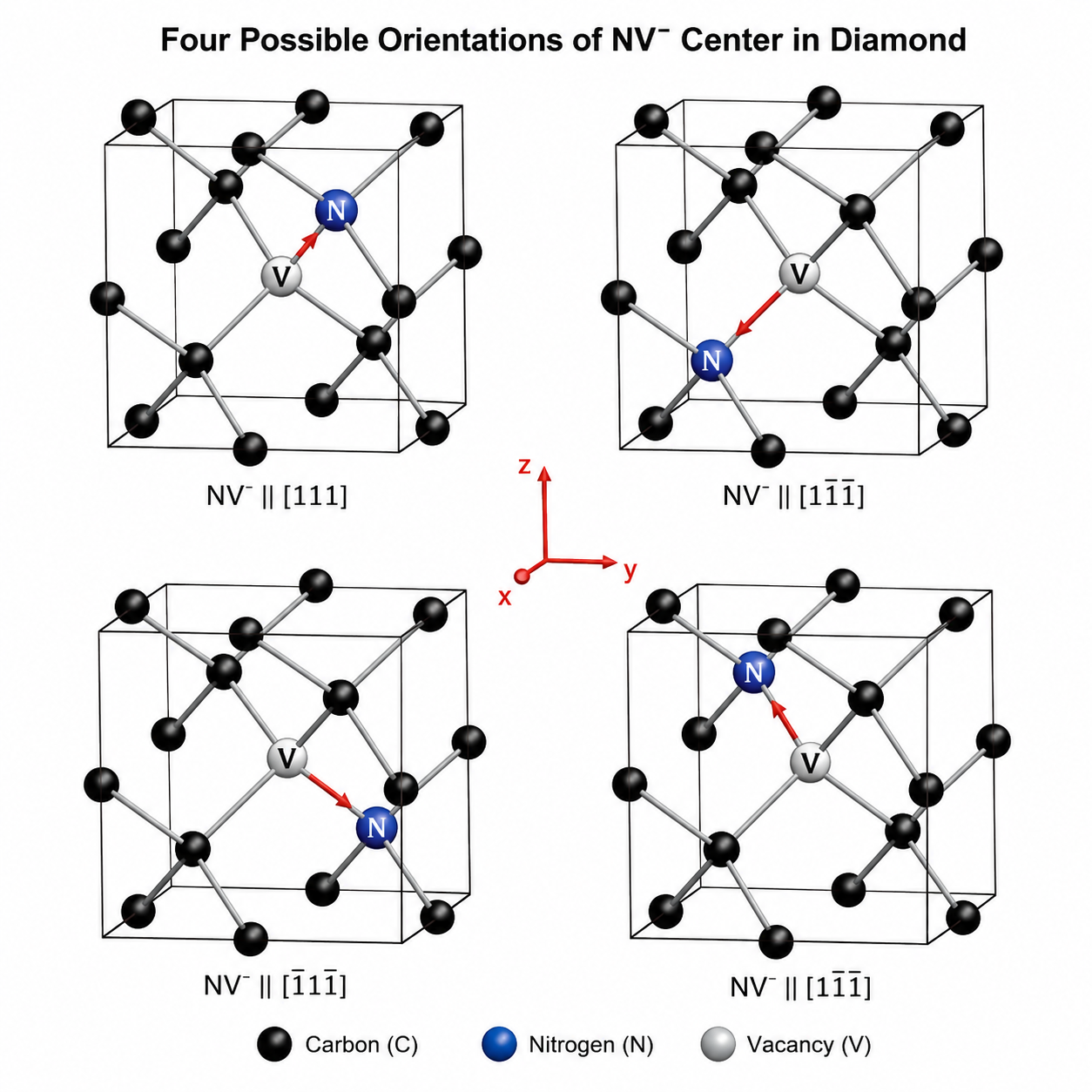
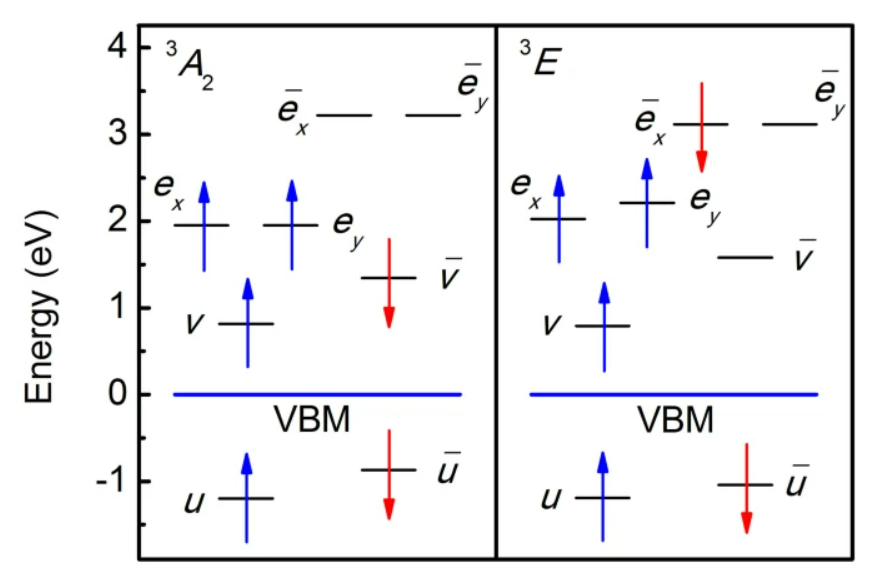
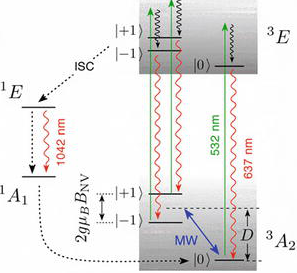
An NV⁻ can be thought of as a 6 electron system or equivalently as a stable octet + dynamical 2 holes system. The dangling electronic orbitals from surrounding 3 Carbon atoms hybridize respecting the C₃ᵥ symmetry of the defect to form three new orbitals: the "a1" orbital is oriented along N-V axis and symmetric about it (the totally symmetric representation), the "e" orbitals are pair of orbitals oriented in the plane perpendicular to the N-V axis. Each electron can be thought of as a superposition of such (a1, e) orbitals. As it turns out, 4 out of the 6 electrons occupy the dangling orbital of N donor and the hybridized a1 orbital. The remaining two electrons are distributed in each of e orbitals. Since these 2 electrons are spinning particles, Hund's rule tell us the triplet configuration (S=1) will be energetically favourable. The exclusion principle tell us that the shared spatial orbital should be anti-symmetric (the A₂ representation of C₃ᵥ). The ground state is therefore denoted by ³A₂ - 3 representing triplet state. Using same argument (S=0) configuration defines the intermediate singlet levels of NV⁻. The Excited state of NV⁻ thus corresponds to the configuration when an electron has been excited from the a1 to e level - Thus the unpaired electrons have different spatial orbitals. Again we have S=1 and S=0 possibilities: S=1 is denoted as ³E and this is what we refer to as excited state of NV in standard literatures. The ZPL is around 637nm and it is the resonant wavelength between ³A₂ and ³E spin sub levels.
Since these two electrons can be interpreted as spinning dipoles - the dipole-dipole interactions between them gives rise to a characterstic 2.87 GHz Hyperfine splitting between ms=0 and ms=±1 spin levels in ³A₂. In experiments, different super-position of electronic spin levels within a manifold can be obtained by resonant excitation with Microwave pulse. This will be important for reading and writing protocol later on. Symmetry argument shows that the optical selection rules between excited and ground spin levels are dependent of excitation laser polarization. Linearly polarized light can excite ³A₂ ms=0 electrons to ³E ms=0 levels, while circularly polarized light are responsible for ms=±1 transitions. Thus we now have a mapping between input photon polarization state and excited electron spin superposition state, enabling us to produce spin-photon entanglement - an essential step towards acheiving quntum memory.
It has been observed that the lifetime of excited electronic spins vary by an order of magnitude depending on which spin level it belongs to. The ms=0 levels of ³E manifold has a tendency to decay radiatively to the groundstate with a typical lifetime of about 12 - 15ns. The ms=±1 levels on the other hand has a probability to decay to metastable singlet levels via two path ways - (1) Spin orbit coupling with 1A1 and 1E singlet levels, but much more dominantly by (2) Phonon interactions. This procedure is called Inter-System Crossing (ISC). The typical lifetime of 1E levels range from 300-400 ns - creating a bottle-neck for ms=±1 electron before they can decay back to ground-state . This has an important consequence: continuous off-resonant excitation with 532nm laser will end up populating groundstate ms=0 levels in each optical cycle much faster compared to ms=±1 counterparts. This process is called charge initialization and is important before any quantum memory protocol.
Before describing these timescales for NV centers specifically, it helps to borrow the language of classical magnetization relaxation, from which the terms T₁ and T₂ originate. Consider a bulk magnetic moment placed in a static magnetic field and briefly tipped away from equilibrium — say, by a resonant pulse. Two independent processes then act on it as it returns to equilibrium: the component of magnetization along the static field slowly regrows toward its equilibrium value, while the component perpendicular to the field — which precesses around it — gradually loses its phase coherence and shrinks to zero. These two independent relaxation processes are captured by two different time constants.
T₁ characterizes how quickly the system returns to its thermal equilibrium population distribution among energy levels — in the magnetization analogy, how quickly the longitudinal component regrows. Physically, this relaxation is driven by an exchange of energy between the spin and its surrounding environment (the "lattice"), so T₁ is often called the spin-lattice relaxation time.
For an NV center, T₁ describes the timescale over which the electron spin's population — its distribution across the ms = 0 and ms = ±1 sublevels of the ground-state triplet — relaxes back to thermal equilibrium after being initialized or perturbed. This relaxation is driven by processes such as phonon-mediated spin-lattice coupling, and it sets the fundamental upper bound on how long any coherence or population state prepared in the spin can, in principle, be preserved — no other coherence time can exceed T₁.
T₂ characterizes how quickly the transverse component of magnetization — the part that carries phase information — decays due to dephasing among an ensemble of spins, or equivalently, the loss of a single spin's own phase coherence over repeated measurements. Unlike T₁, this dephasing does not require any exchange of energy with the environment; it is purely a loss of relative phase, often driven by slowly fluctuating local fields that shift each spin's precession frequency slightly differently.
For an NV center, T₂ describes how long a coherent superposition of spin states (for example, an equal superposition of ms = 0 and ms = −1) survives before it randomizes due to interactions with the surrounding spin bath — most notably residual ¹³C nuclear spins in the diamond lattice, and other paramagnetic impurities such as substitutional nitrogen (P1 centers). T₂ is what is typically probed using a Hahn-echo pulse sequence, which refocuses slow, static-like dephasing and thereby isolates the "true" irreversible coherence loss from reversible inhomogeneous broadening.
T₂* is the dephasing time observed in a simple free-induction-decay measurement, without any refocusing pulse. It captures both the irreversible dephasing mechanisms that also limit T₂, and additional reversible, inhomogeneous dephasing arising from static or slowly varying local field variations — for instance, small differences in the local magnetic environment across an ensemble of NV centers, or slow drifts for a single center measured over many repetitions. Because it includes this extra reversible contribution, T₂* is always shorter than or equal to T₂.
For NV centers, T₂* is typically measured via a Ramsey-type free-induction-decay sequence and is especially sensitive to the local nuclear spin bath and any quasi-static magnetic or electric field noise. The relationship between the three timescales for an NV center follows the general hierarchy T₂* ≤ T₂ ≤ 2T₁, reflecting that inhomogeneous dephasing is the fastest process, true coherence loss (T₂) is slower since reversible dephasing has been refocused out, and population relaxation (T₁) generally sets the longest timescale of the three.