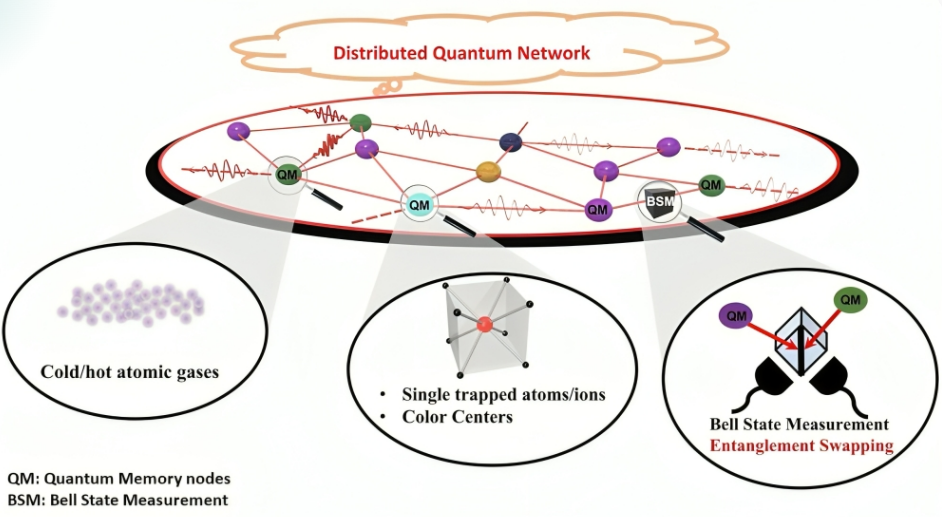
Quantum repeaters provide a protocol and network architecture for enabling long-distance entanglement distribution by dividing a communication channel into multiple shorter segments. Direct transmission of quantum states over long distances suffers from losses in optical fibers. In free space, transmission is affected by beam divergence, atmospheric turbulence, and absorption, all of which degrade the transmitted quantum state. In a quantum repeater, entanglement is first generated locally within individual links and stored in quantum memories. These shorter entangled links are then connected through entanglement-swapping operations based on Bell-state measurements, thereby extending entanglement across the entire network. The successful implementation of such repeater architectures relies on several key components, including high-quality entangled photon sources, efficient quantum memories, synchronization between remote nodes, and reliable Bell-state measurements.
Quantum memories are essential in a quantum repeater because entanglement generation is probabilistic and does not occur simultaneously across all links. A quantum memory allows successfully generated entangled states to be stored until neighboring segments are also ready, enabling subsequent entanglement swapping. Quantum memories can be realized using various platforms, such as nitrogen-vacancy centers, silicon-vacancy centers, and cold atomic ensembles. These memories are characterized by several important parameters, including storage time, efficiency, bandwidth, fidelity, and wavelength compatibility. Since no single quantum memory platform simultaneously provides the best storage time, fidelity, efficiency, bandwidth, and scalability, our project explores multiple complementary memory architectures to leverage the advantages of both atomic and solid-state systems.
This approach necessitates the development of specially engineered SPDC-based entangled photon sources capable of generating narrow-linewidth photons tailored for efficient interaction with the target quantum memory platform. In parallel with the experimental developments, we have also developed a comprehensive simulation framework for SPDC photon-pair generation under realistic operating conditions. The framework incorporates practical imperfections such as detector inefficiencies, pump-beam effects, spectral filtering, and entanglement degradation, enabling accurate modeling and optimization of the source performance.
For more information about the National Quantum Mission, visit the official website .