Special Colloquium
Gravitational Radiation without General Relativity
Speaker: Prof N D Hari Dass (Retd. Senior Professor of Physics, Institute of Mathematical Sciences, Chennai)
In this talk I shall present work done at RRI on gravitational radiation during 1979-80. The trigger for that was the work by Ehlers, Havas and Rosenblum raising serious issues about the existing GR derivations of the Einstein quadrupole formula. I decided to examine the issue from outside the framework of GR by using the spin-2 QFT approach. This was done in two entirely different ways. One was the Feynman graph technique, done in collaboration with Vikram Soni. The other was based on the so called low energy theorems. I will describe both approaches in detail. The punchline was that I was able to establish the correctness of the quadrupole formula. I shall bring out various nuances and discuss future prospects.
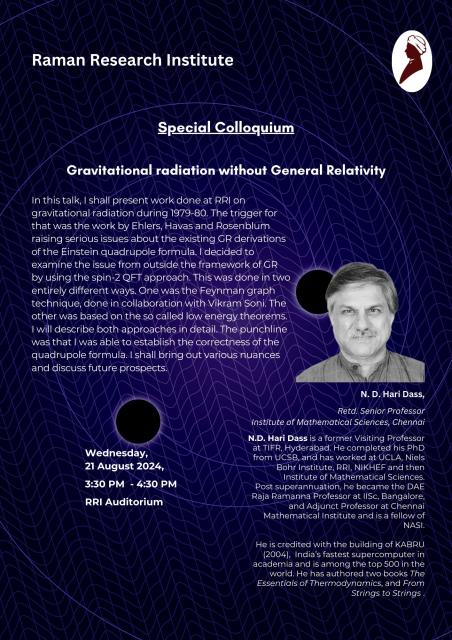
He obtained his BSc(Hons) and MSc in Physics from Delhi University and his Ph.D. from UCSB. Subsequently, he worked at UCLA, Niels Bohr Institute, RRI,
and NIKHEF, Amsterdam, before joining the Institute of Mathematical Sciences in Chennai.
He retired from there as a Senior Professor and became the DAE Raja Ramanna Professor at IISc, Bangalore, and Adjunct Professor at Chennai
Mathematical Inst. He is a fellow of the National Academy of Sciences, Allahabad. His current research interests are in high energy
physics, astrophysics,and foundations of quantum mechanics.
He is passionate about teaching in general and in raising awareness about science.
In 2004 he built India’s fastest supercomputer in academia, KABRU, which was among the top 500 supercomputers in the world. He has authored
the book “The Essentials of Thermodynamics†(SRI Publishers, Singapore). His second book 'From Strings to Strings' on strong interactions, has
just been released by Springer as a Lecture Notes in Physics.