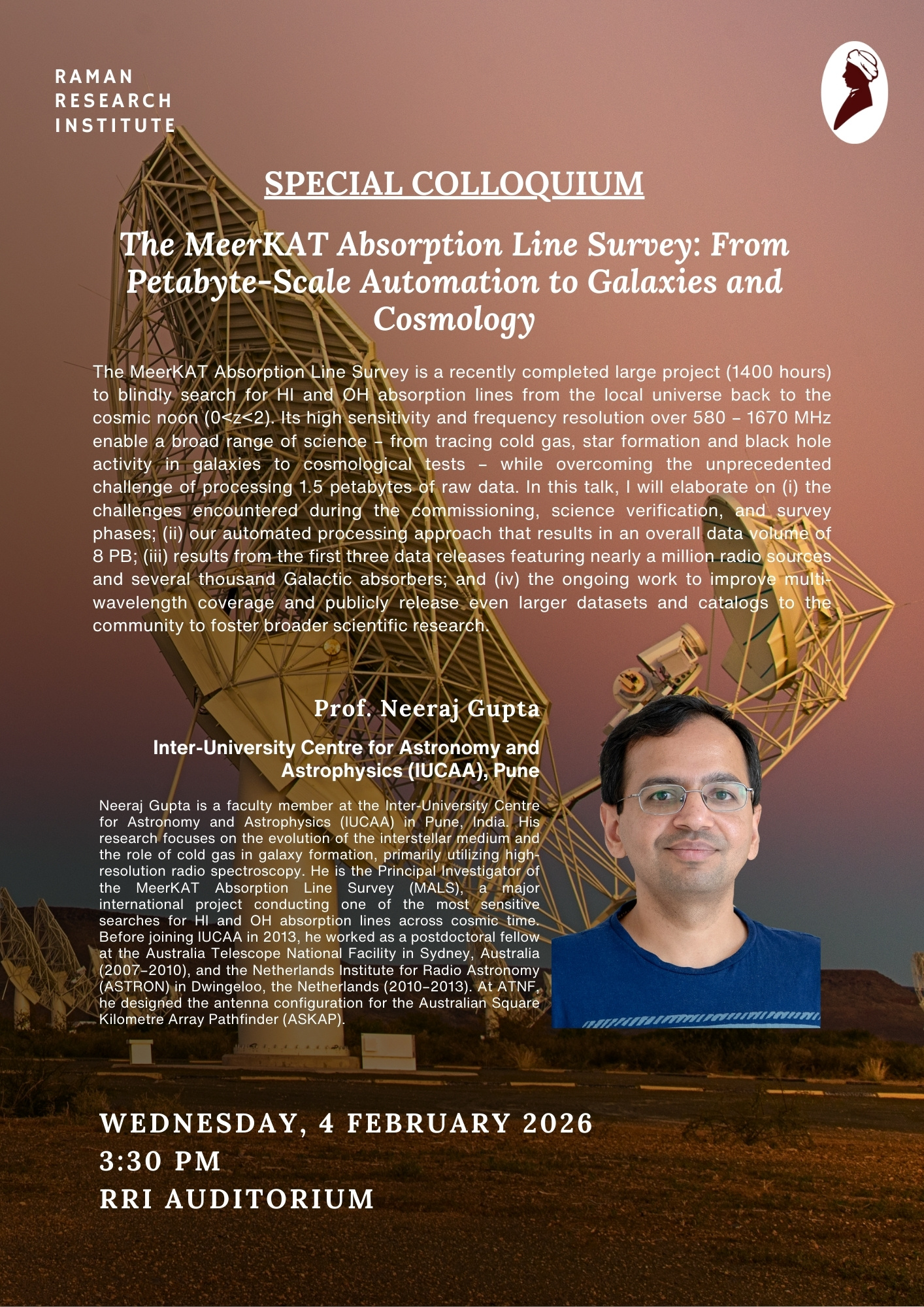
Special Colloquium
The MeerKAT Absorption Line Survey: From Petabyte-Scale Automation to Galaxies and Cosmology
Speaker: Professor Neeraj Gupta (Inter-University Centre for Astronomy and Astrophysics (IUCAA), Pune, )
The MeerKAT Absorption Line Survey (MALS; https://mals.iucaa.in/) is a recently completed large project (1400 hours) to blindly search for HI and OH absorption lines from the local universe back to the cosmic noon (0<z<2). Its high sensitivity and frequency resolution over 580 – 1670 MHz enable a broad range of science – from tracing cold gas, star formation and black hole activity in galaxies to cosmological tests – while overcoming the unprecedented challenge of processing 1.5 petabytes of raw data. In this talk, I will elaborate on (i) the challenges encountered during the commissioning, science verification, and survey phases; (ii) our automated processing approach that results in an overall data volume of 8 PB; (iii) results from the first three data releases featuring nearly a million radio sources and several thousand Galactic absorbers; and (iv) the ongoing work to improve multi-wavelength coverage and publicly release even larger datasets and catalogs to the community to foster broader scientific research.