Special Colloquium

Special Colloquium

Quantum Systems and Devices Built of Ultracold Atoms and Light.

Speaker: Prof. Dan Stamper-Kurn (University of California, Berkeley.)

तिथि और समय
कार्यक्रम का स्थान
RRI Auditorium

अमूर्त

The "modern" theory of quantum mechanics is over 100 years old. Even with this long history, there is a surge of new interest in quantum mechanics, owing to the belief that complex engineered quantum systems can serve valuable new functions in the areas of computation, communication, sensing, and simulation of natural phenomena. I will describe efforts in my Berkeley research group where we engineer controlled quantum systems, and putative quantum devices, using two main ingredients: ultracold atoms (cooled to temperatures in the micro- and even nano-Kelvin range) and quantum states of light. I will touch on several applications of such systems, illustrating not only their potential utility, but also how they bring fundamental concepts in quantum mechanics to light.
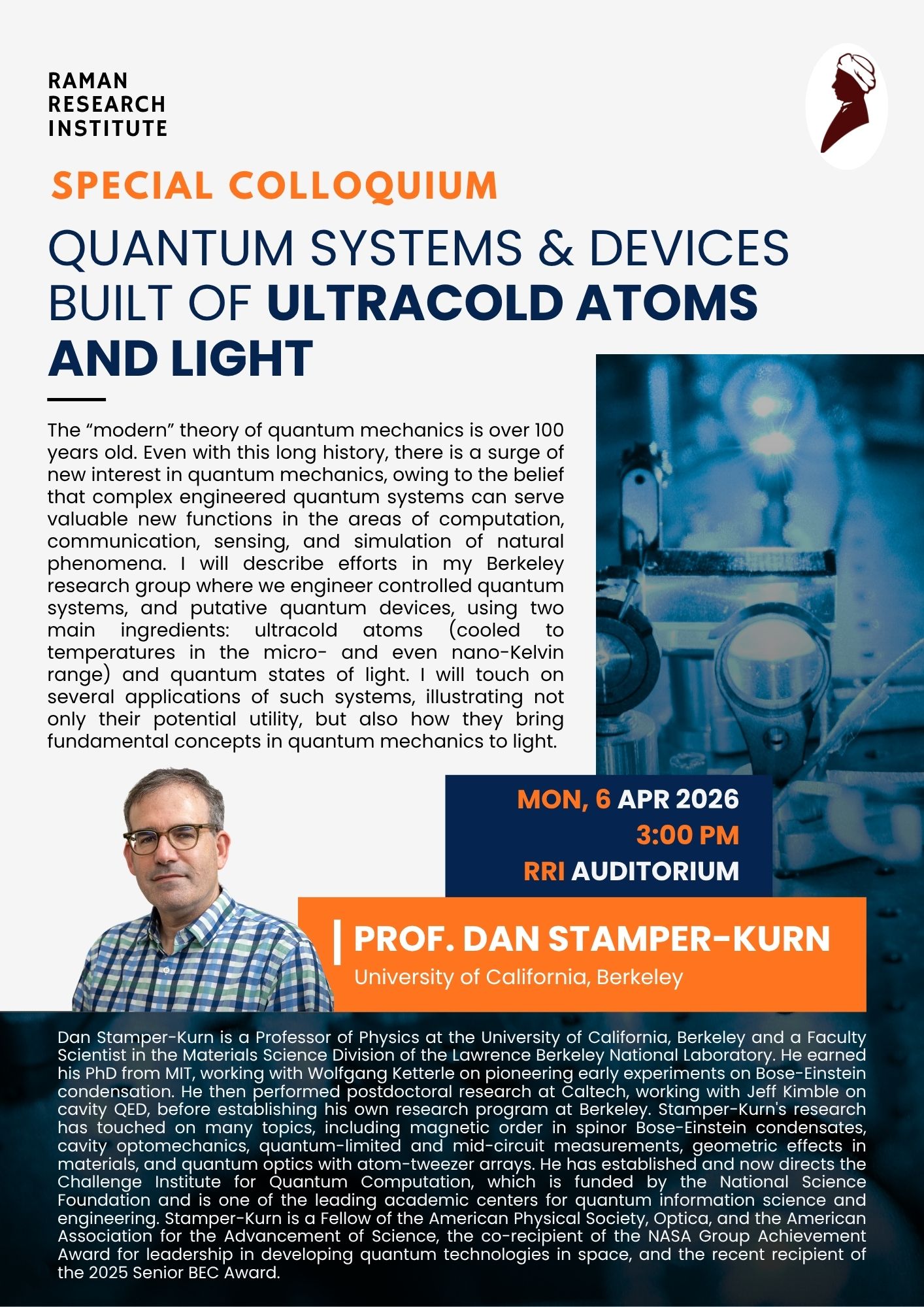
 

Poster
Poster
Prof. Dan Stamper Kurn

Short Biography
Dan Stamper-Kurn is a Professor of Physics at the University of California, Berkeley and a Faculty Scientist in the Materials Science Division of the Lawrence Berkeley National Laboratory. He earned his PhD from MIT, working with Wolfgang Ketterle on pioneering early experiments on Bose-Einstein condensation. He then performed postdoctoral research at Caltech, working with Jeff Kimble on cavity QED, before establishing his own research program at Berkeley. Stamper-Kurn's research has touched on many topics, including magnetic order in spinor Bose-Einstein condensates, cavity optomechanics, quantum-limited and mid-circuit measurements, geometric effects in materials, and quantum optics with atom-tweezer arrays. He has established and now directs the Challenge Institute for Quantum Computation, which is funded by the National Science Foundation and is one of the leading academic centers for quantum information science and engineering. Stamper-Kurn is a Fellow of the American Physical Society, Optica, and the American Association for the Advancement of Science, the co-recipient of the NASA Group Achievement Award for leadership in developing quantum technologies in space, and the recent recipient of the 2025 Senior BEC Award.