Special Colloquium
Viscoelastic Flows at the Microscale: From Microfluidic Instabilities to Filament Stability
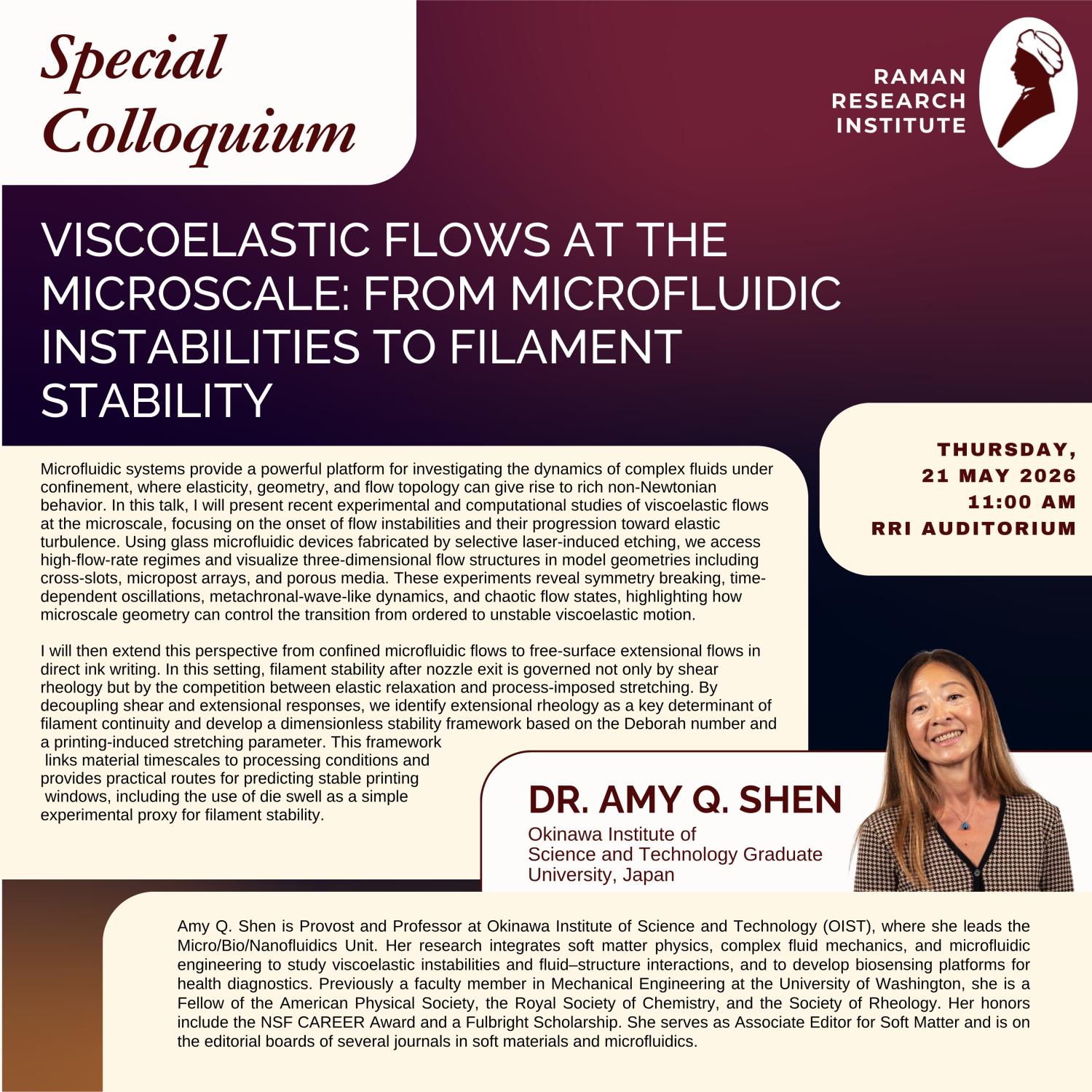
Speaker: Amy Q. Shen ( Okinawa Institute of Science and Technology Graduate University, Japan)
Microfluidic systems provide a powerful platform for investigating the dynamics of complex fluids under confinement, where elasticity, geometry, and flow topology can give rise to rich non-Newtonian behavior. In this talk, I will present recent experimental and computational studies of viscoelastic flows at the microscale, focusing on the onset of flow instabilities and their progression toward elastic turbulence.
Using glass microfluidic devices fabricated by selective laser-induced etching, we access high-flow-rate regimes and visualize three-dimensional flow structures in model geometries including cross-slots, micropost arrays, and porous media. These experiments reveal symmetry breaking, time-dependent oscillations, metachronal-wave-like dynamics, and chaotic flow states, highlighting how microscale geometry can control the transition from ordered to unstable viscoelastic motion.
I will then extend this perspective from confined microfluidic flows to free-surface extensional flows in direct ink writing. In this setting, filament stability after nozzle exit is governed not only by shear rheology, but by the competition between elastic relaxation and process-imposed stretching. By decoupling shear and extensional responses, we identify extensional rheology as a key determinant of filament continuity and develop a dimensionless stability framework based on the Deborah number and a printing-induced stretching parameter. This framework links material timescales to processing conditions and provides practical routes for predicting stable printing windows, including the use of die swell as a simple experimental proxy for filament stability.

Micro/Bio/Nanofluidics Unit. Her research integrates soft matter physics, complex
fluid mechanics, and microfluidic engineering to study viscoelastic instabilities,
fluid–structure interactions, and develop biosensing platforms for health
diagnostics. Previously a faculty member in Mechanical Engineering at the University
of Washington (USA), she is a Fellow of the American Physical Society, the Royal
Society of Chemistry, and the Society of Rheology. Her honors include the NSF
CAREER Award and a Fulbright Scholarship. She serves as Associate Editor for Soft
Matter and is on the editorial boards of several journals in soft materials and
microfluidics.