Indian scientists predict the Sun’s magnetic crown for the eclipse to be witnessed over Europe
[Posted on 13 August 2026]
Article by Unnati Ashar
Update:
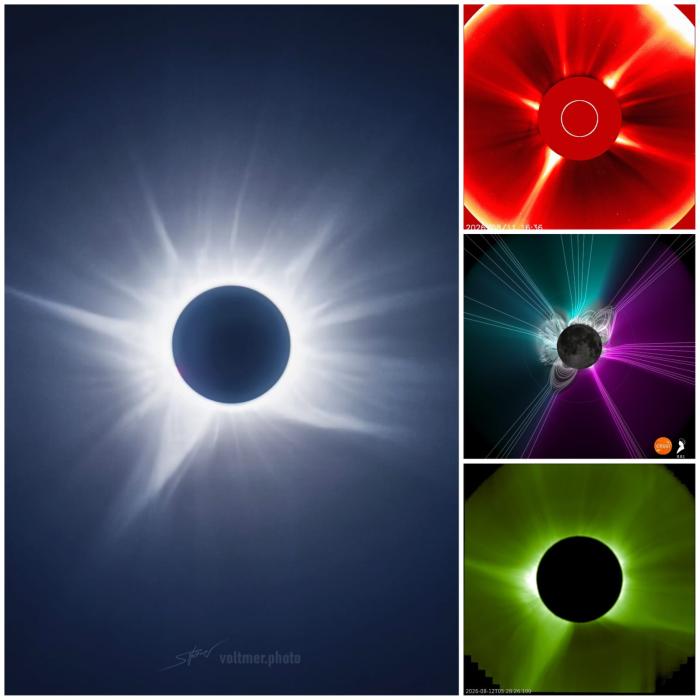
Images from actual observations, which are usually the best for comparing predictions, are in. As can be seen in the image above, barring an extra elongated structure going to the bottom right in the prediction panel, the other petal-like and elongated structures predicted by the RRI team and collaborators match the observations.
Solar physicists at the Raman Research Institute (RRI), along with collaborators, have predicted the tangled magnetic structure of the seething million-degree atmosphere of the Sun during the total solar eclipse of 12 August 2026.
On 12 August 2026, a total solar eclipse, a rare celestial event, will sweep across many countries in Europe. A group of Indian solar physicists and space weather scientists led by RRI, an autonomous institute of the Department of Science and Technology, have predicted the structure of the Sun’s outer atmosphere or its “crown”, called the corona.
On the day of the eclipse, their prediction indicates the presence of multiple large-scale petal-like structures and more local, elongated petals. If this turns out to be true, the Sun’s corona during the 12 August 2026 eclipse would be quite complex and spectacular. The live updates of their predictions can be seen here: https://wwws.rri.res.in/solareclipse2026/ . The RRI team will post observations from professional photographers on this website as they make them available after post-processing. These are usually the best for comparing predictions. The team will update this website to show how accurately their predictions align with the observations.
Why did scientists even bother to predict an eclipse not visible from India?
A total solar eclipse offers the best chance for ground-based coronal observations that can help test theories and models of the Sun's corona. These models are essential in understanding the origin of solar storms— sudden explosions of material and energy blasted by the Sun. It is with the aim to understand the Sun's corona that scientists chase solar eclipses across continents with their instruments. And it is with this same aim that theorists and modelers like the RRI team recreate the magic of the Sun using physics and computers.
Testing models of solar magnetism and space weather through eclipse observations is an important global exercise pursued by about five research groups with such modelling capabilities in the United States, Europe and India. The research group of Dibyendu Nandi, senior professor in the Astronomy and Astrophysics theme at RRI, is one such group.
Nandi’s group has established expertise in predicting the coronal structure during solar eclipses multiple times in the past.
How is the prediction made?
The team utilized a novel approach that employs two distinct computational models, rooted in the theoretical framework proposed by Nandi and colleagues, to predict the structure of the Sun's coronal magnetic field. They utilized a data-driven model with built-in memory spanning multiple years. This model is run forward to 12 August 2026 to predict the Sun's surface magnetic field distribution on that day, incorporating data from the solar surface as observed until 10 August 2026. “Calibrating the model with past solar observations is essential to obtain accurate estimations,” says Nandi.
“We strive to continuously improve our models by comparing our simulated predictions with observations – the best test for any theoretical model,” says Nandi. “Improved modelling approaches and constraining the underlying theory help us build better models for predicting solar magnetic field dynamics and space weather. This is how scientific progress is achieved.”
About the August 2026 total solar eclipse
In a total solar eclipse, the entire visible disk of the Sun is occulted by the Moon, turning day into night for a few minutes.
The eclipse will start at 9.04 pm IST on August 12, 2026, and the Moon’s shadow will cover the Sun for two minutes and 18 seconds.
The eclipse won’t be visible from India as it will be nighttime then. Much of Spain will get to savor the total solar eclipse. Western Europe, parts of northwestern Africa and some parts of the U.S. will see a partial solar eclipse.
Why study the corona?
The solar corona is very faint compared to the bright solar surface. It is extremely hard to observe the corona unless an object occults the bright solar disk. This occulting object can be the Moon while passing in front of the Sun or an artificial disk mounted on a satellite— a coronagraph. India's Aditya-L1 satellite carries such a coronagraph, as does the European Space Agency’s Solar and Heliospheric Observatory and the Proba-3 mission. The latter ESA mission, a novel twin-spacecraft coronagraph concept, was launched by ISRO.
Solar eclipses during occultation by the Moon provide excellent opportunities to study the Sun's corona. But why study the corona at all?
Coronal magnetic field dynamics lead to solar flares, solar storms, and coronal mass ejections (CMEs). The eruption of plasma and charged particles from the Sun during these events affects the Earth's outer atmosphere and its technologies leading to power outages and disruption of communication and GPS networks. They can also damage satellites and harm astronauts orbiting around the Earth jeopardizing their health through doses of high radiation and energetic particles. As we get increasingly dependent on space-reliant technologies, it becomes imperative to study these solar phenomena and develop the understanding to be able to predict these events.
Observation of the solar corona during eclipses has the potential to constrain theoretical and computational models of coronal magnetic fields, which are expected to yield better forecasting capabilities for destructive space storms. These observations can also constrain the physical processes that heat the Sun’s corona to a super-hot million degrees. Such computational models enhance understanding of solar activity and enable space weather forecasting.
The forecasting team led by Nandi included Sagnik Saha from the Raman Research Institute, Priyansh Jaswal from the Center of Excellence in Space Sciences India at IISER Kolkata, Shaonwita Pal from the Indian Institute of Astrophysics and Department of Technical Education and Skill Development, Government of West Bengal, Soumyaranjan Dash from the United States National Solar Observatory and Chitradeep Saha from the University of Reading, UK.