Beyond one: Indian researchers measure a quantum surprise
[Posted on 24 September 2026]
Article by Unnati Ashar
Imagine a photon shooting out from a laser. It hits a mirror, cuts through a beamsplitter, makes its way across a polariser, and finally strikes the detector. The detector clicks. One knows the final outcome of the photon hitting the detector. But what happened between the initial emission and the final detection of the photon?
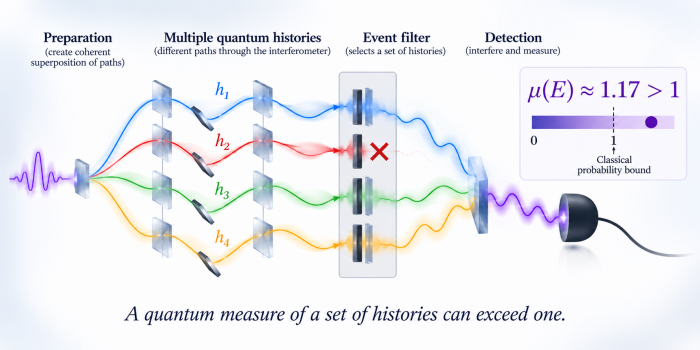
Looking only at the final detector click does not identify a unique route by which the photon arrived. Now, a new experiment from the Raman Research Institute (RRI), an autonomous institution funded by the Department of Science and Technology, gives experimental access to a quantity associated with a chosen collection of photon paths: the “quantum measure”.
In a future implementation, a filter could select a chosen collection of photon paths while leaving the photons available for further quantum operations. That could potentially turn this “event-filtering” into a new tool for quantum measurement, quantum computing or quantum information processing.
Many quantum experiments focus on the outcomes of measurements made at particular times. For example, one may know where a photon was detected at the end of an experiment. But quantum theory asks a much harder question: can one say anything meaningful about the physical process between the beginning and the end? This study, published today in the journal Quantum, shows that for a particular class of questions, one can.
The Quantum Measure Theory
Imagine travelling from Bangalore to Delhi. One can ask, “Did you arrive in Delhi?” That is like a conventional quantum measurement that only looks at the final outcome. But suppose instead one asks, “Did you go from Bangalore through Mumbai and Hyderabad to Delhi?” This is closer to the way Quantum Measure Theory (QMT), which is the beating theoretical heart of this new study, thinks. QMT is a histories-based formulation of quantum mechanics. A “history”, in simple terms, is a route or path that the photon could take in an optical experiment. In this experiment, the question concerns a collection of alternative routes, rather than a single fixed itinerary.
The difference in emphasis between standard quantum mechanics and its histories-based formulation can be better understood through the analogy of a photograph and a movie. Conventional measurement questions often resemble asking about a photograph: what is the state of the system at a particular time? A history-based formulation of quantum mechanics instead considers the whole movie: what are all the possible ways in which the system evolved from the beginning to the end? Both descriptions allow us to study time evolution; the histories-based approach makes complete histories and collections of histories central to the description.
Measuring the quantum measure
To make the QMT experimentally accessible, RRI physicists started constructing an “event-filter” on their optical table that would select a set of photon routes. A set of routes is called an event. Sanchari Chakraborti, then a PhD student at RRI, performed the experiment under the supervision of Urbasi Sinha, co-author of the paper and senior professor, RRI.
To build this event-filter, they first allowed the photons in the laser beam to traverse the different routes or histories in their optical setup. They then used polarisation, which tells the orientation in which the light waves are oscillating, to label and distinguish different possible routes, select the particular collection of routes they wanted, and remove the ones they didn’t. Later, they erased the distinguishing information so that the routes could interfere again. In the reported experiment, the researchers measured input and output laser powers to infer the equivalent photon-detection probability. They then used a known calibration of the event-filter to determine the “quantum measure” of the chosen collection of routes.
The quantum measure assigns a weight to a chosen collection of photon routes. They measured a quantum measure of about 1.17, agreeing within experimental uncertainty with the prediction of about 1.18 after accounting for imperfections in the apparatus. The value of 1.17 immediately showed in a striking manner that the quantum measure was behaving differently from the ordinary classical probability that cannot exceed one.
Then how did the quantum measure exceed one? Well, strangeness can’t be far behind when one enters the realm of quantum mechanics. In the quantum world, the contributions from different possible photon routes can also interfere with one another like waves: when crests of two waves overlap, they create a bigger wave. This allows the quantum measure that includes interference between the routes to exceed one. “That does not mean that something happened with 117 per cent probability. … The important caveat is that we have not measured a probability greater than 100 per cent,” says Sinha. The detector probability remains an ordinary probability below one. What can exceed one is the quantum measure.
The study demonstrates for the first time an event-filter measurement of a quantum measure exceeding one. It shows that this quantity is not merely an abstract concept that can be calculated on paper: it can be measured experimentally. “There is something particularly satisfying about seeing an idea that grew out of fundamental questions about quantum mechanics become a real optical experiment on a laboratory table. We are not claiming that this resolves the quantum measurement problem,” says Sinha. “But we have enlarged the class of questions about quantum processes that can be connected to an experimental measurement.”
Losing a luminary
The quantum measure is at the heart of QMT. Rafael Sorkin, who is also the study’s co-author, developed QMT partly from the search for ways of formulating quantum physics that are natural for spacetime and, ultimately, quantum gravity. Sorkin helped shape, over decades, ideas about quantum mechanics, spacetime and quantum gravity. History-based formulations like QMT are attractive when thinking about spacetime because it’s a four-dimensional history rather than a sequence of snapshots. “I want to stress, however, that this is not an experiment on quantum gravity, nor does it test any theory of quantum gravity,” says Sinha.
Unfortunately, Sorkin passed away on 12 September 2026, in Ontario, Canada. He’s best known for introducing the “causal set approach” to quantum gravity and was an institution in himself. He was a researcher emeritus at the Perimeter Institute for Theoretical Physics, Canada. Sorkin was a Distinguished Visiting Faculty member at RRI at the time of his passing. He had been associated with RRI since 2011.
“Working with Rafael has been one of the most intellectually rewarding parts of this project. Rafael had a remarkable ability to begin with questions that sound almost deceptively simple: What exactly are we measuring? What do we mean when we say that an event happened? What can an experiment legitimately tell about what occurred between preparation and detection? Following those questions seriously takes one surprisingly deep into the foundations of quantum theory,” says Sinha on working with Sorkin. “This paper means a great deal to me personally as well as scientifically.”
Measuring a Quantum Measure Exceeding Unity – Quantum
Read more Research Highlights here.
For more details, contact: outreach@rrimail.rri.res.in