Founder’s Day Lecture
Metavalent Bonds: Crystals in Love with Instabilities
Speaker: Prof. Umesh Waghmare (Secretary, Department of Science and Technology (DST), Government of India.)
Raman effect is observed when light scattered by a molecule or a crystal changes its color by losing or gaining energy from the vibrations of a host. Peaks in a Raman spectrum are thus associated with natural frequencies of vibrations, providing a window into the nature of chemical bonding of the host. Rocksalt crystals of group IV-chalcogenides (for example, GeTe, PbTe) exhibit rather unusual chemical bonds that make vibrational modes ultra-sensitive to electric field and lattice deformation, not fitting within the conventional pictures of chemical bonds. While metavalent (intermediate to metallic and covalent) bonding (MVB) was introduced to describe them, the governing electronic mechanisms have been debated for over 50 years. Using first-principles quantum mechanical analysis of a variety of rocksalt crystals, we demonstrate that
(a) their metavalent bonding is a consequence of weakly broken translational symmetry of metalloids,
(b) they are susceptible to various electronic and phonon instabilities whose couplings cause their rich and unusual properties, and
(c) MVB is governed by multi-center mixed bonding and anti-bonding p-p interactions along linear chains.
While the cubic symmetry does not permit any Raman-active phonons, we predict them to exhibit colossal second-order Raman scattering with observable consequences. Strong coupling between their symmetry breaking Instabilities is shown to cause nontrivial geometric (aka Berry or Pancharatnam) phases, enabling some of them to host nontrivial electronic topology.
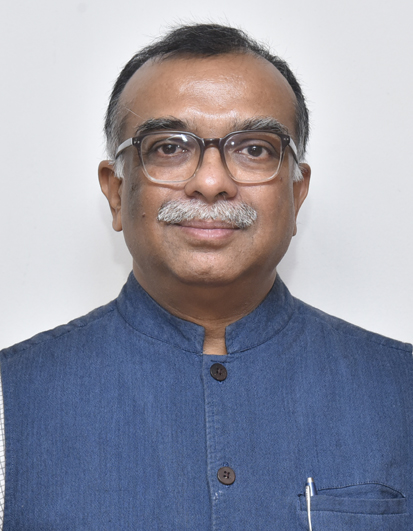
His research has led to an atomistic understanding of a variety of technologically important materials, having made significant contributions to ab initio modeling and simulations of multifunctional materials, mechanical behavior, nanostructures, quantum geometry, topological insulators, and materisis for energy and environment.
He was a co-founder of a startup. Breathe Applied Sciences PVT Ltd., which engages in the reduction of CO,. the greenhouse gas relevant to global warming. He is an Associate Editor of NanoScale and NanoScale Advances. He is a recipient of the DuPont Young Faculty grant award (2003), MRSI medal (2004), BM Birla award for Physics (2005), DAE outstanding research investigator award (2009), IBM Faculty Award (2009), SS Bhatnagar prize in Physical. Sciences (2010), the Infosys Prize in Engineering and Computer Science (2015) and GD Birla award for scientific research (2016). He was recognized as a distinguished alumnus by IIT Bombay in 2017 and received the MRSI Distinguished Materials Scientist of the Year award (2024) of the Materials Research Society of India. He is a Fellow of the Indian Academy of Sciences, the National Academy of Sciences, Allahabad, the Indian National Science Academy, the Indian National Academy of Engineering, and the Maharashtra Academy of Sciences.