Pancharatnam Lecture
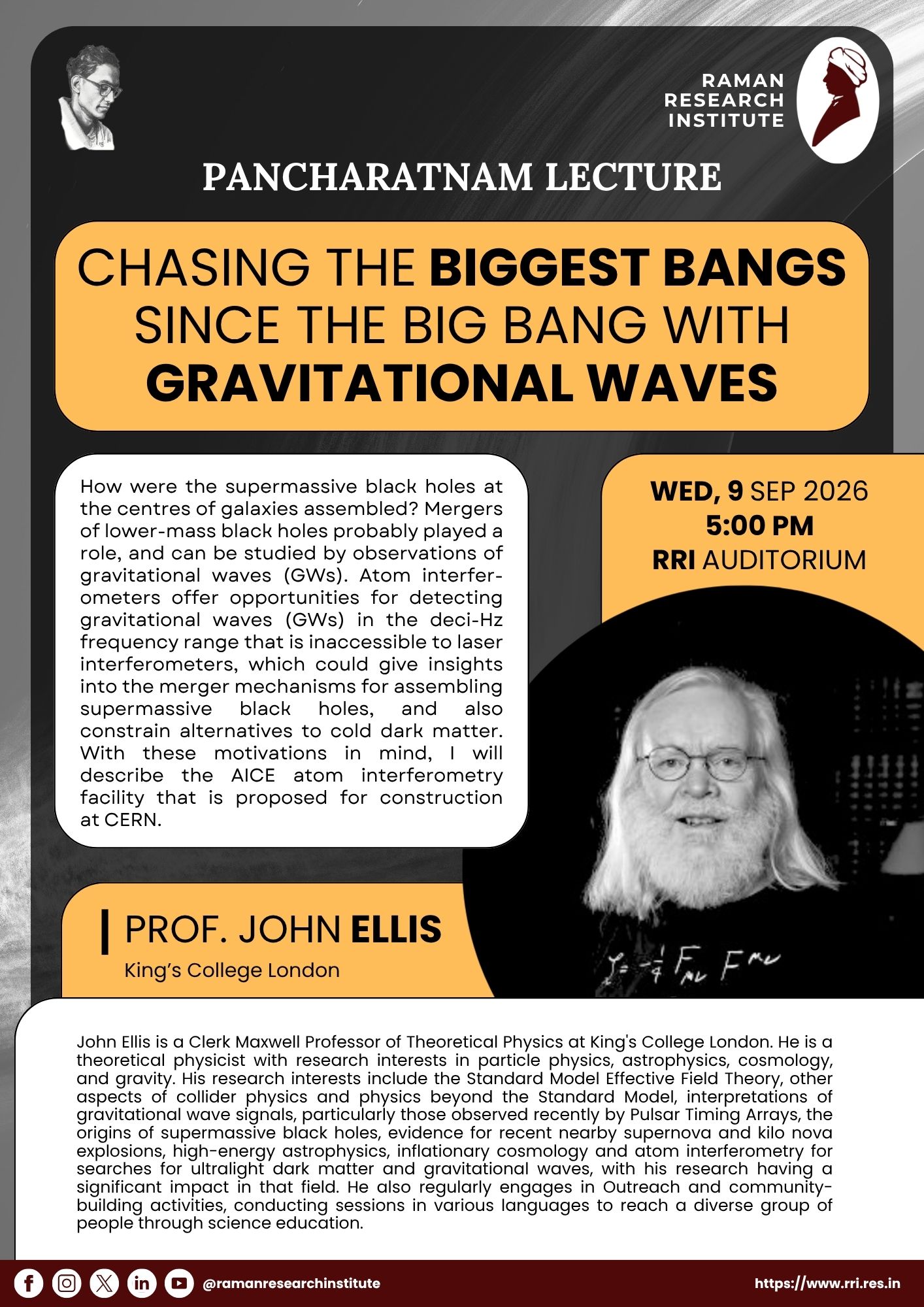
Chasing the Biggest Bangs since the Big Bang with Gravitational Waves
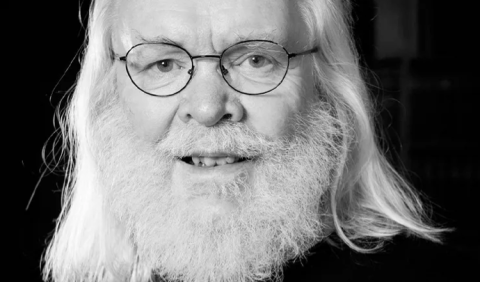
Speaker: Professor John Ellis (King's College, London.)
Date and time
Webinar link
Venue
RRI Auditorium
Abstract
How were the supermassive black holes at the centres of galaxies assembled? Mergers of lower-mass black holes probably played a role, and can be studied by observations of gravitational waves (GWs). Atom interferometers offer opportunities for detecting gravitational waves (GWs) in the deci-Hz frequency range that is inaccessible to laser interferometers, which could give insights into the merger mechanisms for assembling supermassive black holes, and also constrain alternatives to cold dark matter. With these motivations in mind, I will describe the AICE atom interferometry facility that is proposed for construction at CERN.
Poster
Short Biography
John Ellis is a Clerk Maxwell Professor of Theoretical Physics at King's College London. He is a theoretical physicist with research interests in particle physics, astrophysics, cosmology. and gravity. His research interests include the Standard Model Effective Field Theory, other aspects of collider physics and physics beyond the Standard Model, interpretations of gravitational wave sigrials, particularly those observed recently by Pulsar Timing Arrays, the origins of supermassive black holes, evidence for recent nearby supernova and kilo nova explosions, high-energy astrophysics, inflationary cosmology and atom interferometry for searches for ultralight dark matter and gravitational waves, with his research having a significant impact in that field. He also regularly engages in Outreach and community-building activities, conducting sessions in various languages to reach a diverse group of people through science education.