RRI scientists study the uneven patterns in how structures recover after temperature changes
[Posted on 2 September 2026]
Article by Unnati Ashar
Illustrations by Arunima V
Video by Rahul Iyer
While humans sometimes struggle to erase memories they wish to forget, researchers at the Raman Research Institute (RRI) have unlocked a way to wipe out memories, albeit not in humans, but in glasses.
“Glasses can remember. For the glass to stop remembering, you need it to go to a liquid state. What our work showed is how you can momentarily get the glass to a liquid state,” says Ranjini Bandyopadhyay, Senior Professor in the Soft Condensed Matter group at RRI, an autonomous institution of the Department of Science and Technology, and co-author of the study published in the Journal of Colloid and Interface Science. Her group has uncovered a way to make jammed systems flow momentarily by giving them temperature shocks. Their study could have far-reaching implications in areas such as drug delivery.
Floppy particles, hard material
For the experiment, Sonali Kawale, first author on the paper and PhD student at RRI, jam-packed squishy particles so that they resemble hard materials, to be specific, glass, which has particles in disorder inside it. “While [glasses] exhibit mechanical properties akin to those of solids, their structural characteristics resemble those of liquids,” says Kawale. The floppy particles Kawale used were made of microgels, a material that can absorb 300-500 times its weight in water and is used in diapers and sanitary napkins. “Squeezing is never a good thing. In an ideal environment, these particles would like to move around. But they can’t do that. So, they’re unhappy. … If the whole thing starts flowing, that’s a happy situation,” says Bandyopadhyay. “We found a way in which you can get them a little happier.” The process by which a system tries to flow and reach its minimum energy state is known as structural recovery.
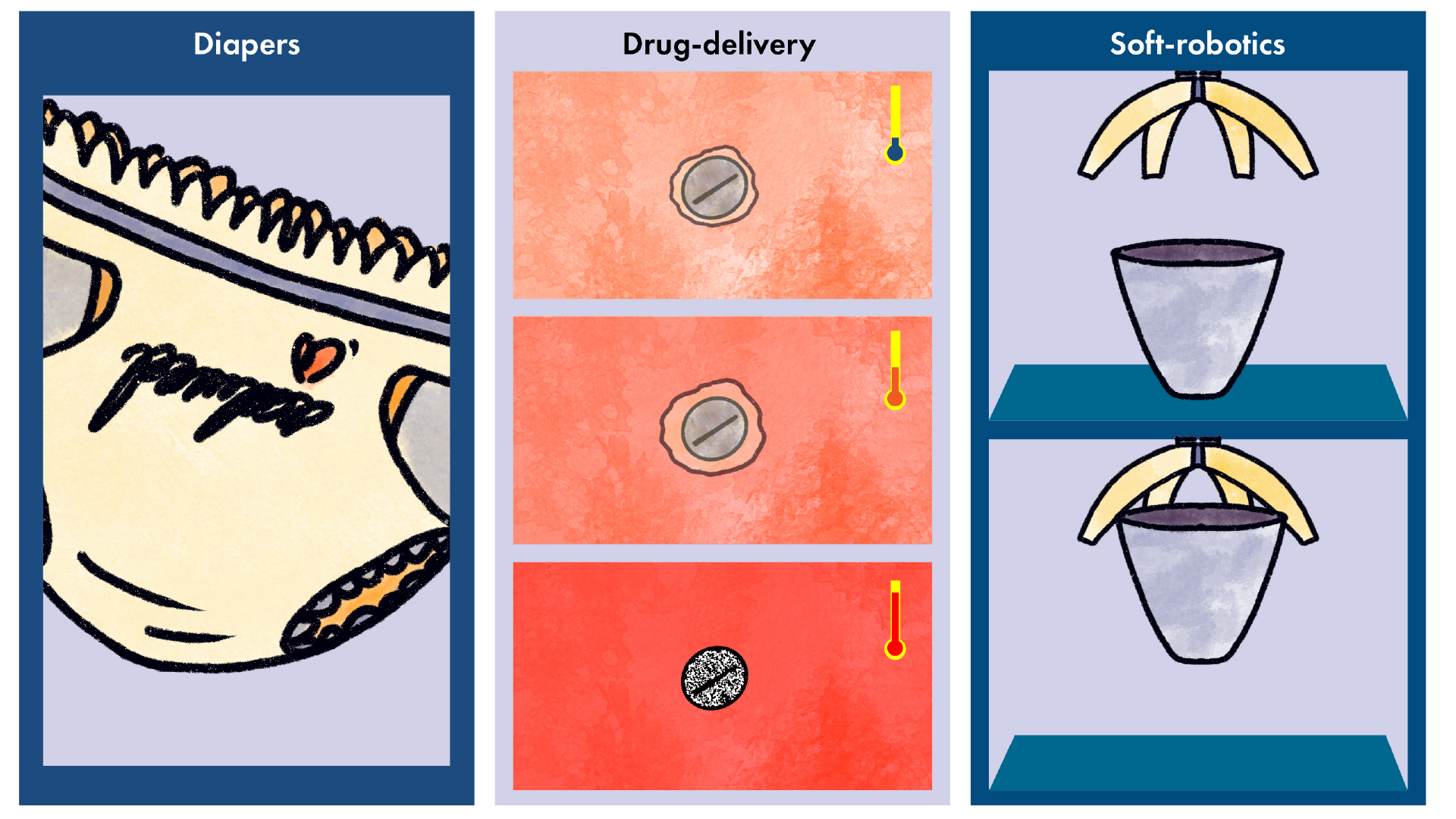
Fig 1. Various uses of microgel particles: (a) due to their enhanced ability to absorb liquids, they are often used in diapers (b) being thermo-responsive, they are used as coatings in medicine, that later disintegrates with exposure to high-temperatures and allows the drug to interact with the body, and (c) due to their nature, they are used to create flexible material that mimics biological material.
Kawale first synthesised microgel particles in a three-neck round-bottom flask and ground them to a fine powder using a mortar and pestle. Next, she created a suspension of this microgel powder by adding it to water. She then subjected the samples to stirring for 24 hours, sonicated (agitated with sound waves) them for 15 minutes, and refrigerated them at four degrees Celsius, where they remained stable enough to use for months.
Blow hot and cold
To ensure that the sample was first in a liquid state, she heated it to 35°C. She then cooled the sample to 15°C. After taking measurements here, she applied a temperature ramp, and took the sample to 20°C. She repeated the same cycle for the cooling process, bringing the sample down from 25 to 20°C.
The team found that the path the suspension followed to reach the target temperature of 20°C during heating differed from that during cooling. There was no mirror symmetry. Instead, there was what scientists call ‘asymmetry’ in the path the suspension took during the heating and cooling processes. “The way it tries to reach the final temperature which you’re trying to impose on the system, that’s totally different,” says Bandyopadhyay.
“Because it is path-dependent, you could say that there’s some memory that’s being retained. … The asymmetry tells you that the points in between do really matter,” says Bandyopadhyay. So, the system depends not only on the initial and final temperatures, but also on the path taken.
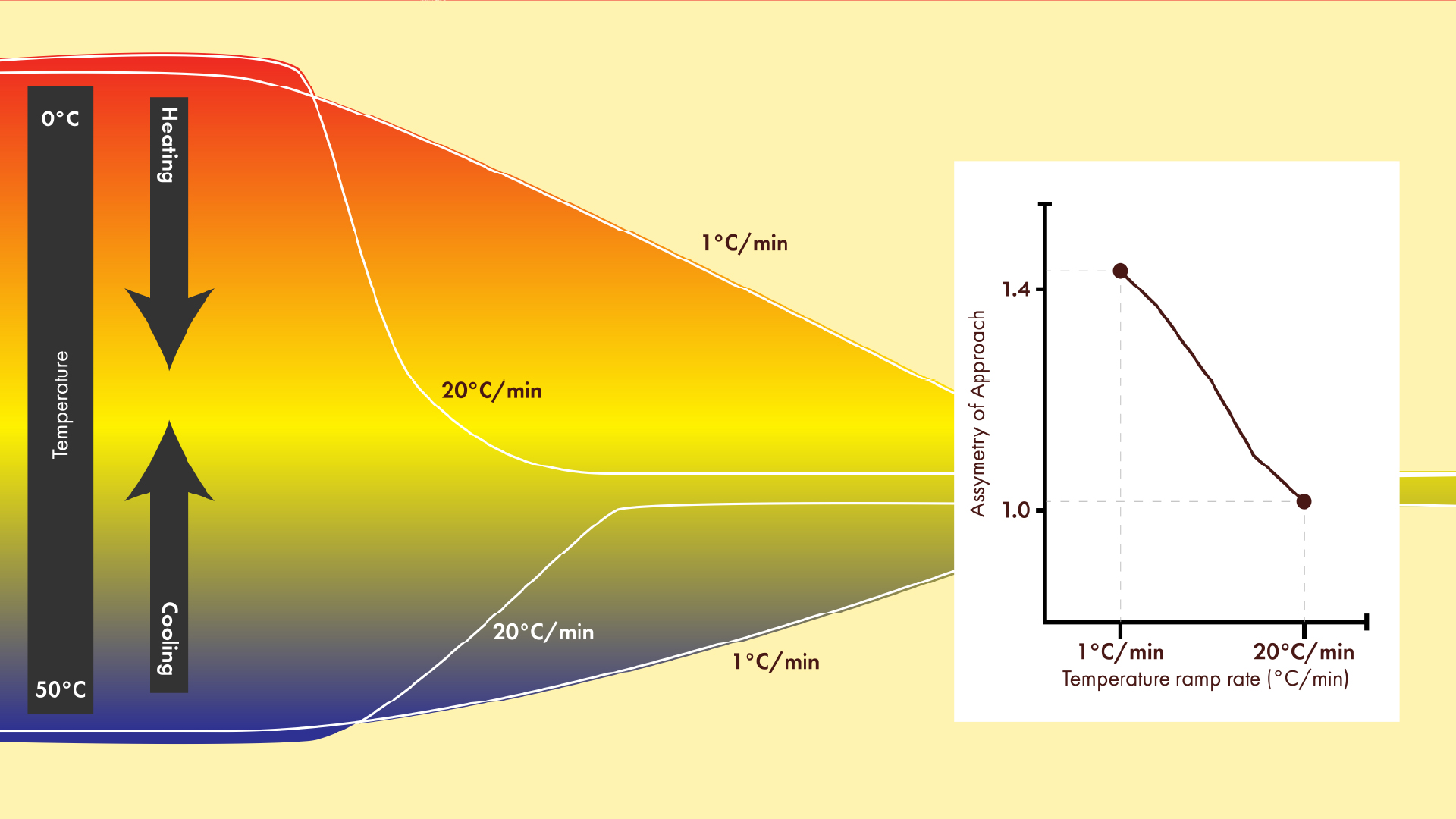
Fig 2. Providing temperature shocks can help control the asymmetries in the system
Making glasses forget
Scientists have investigated asymmetries in the path of structural recovery before. Kawale and colleagues set out to do the same. But when they tried to impose a specific temperature on the system, they encountered challenges: the temperature control system would take sudden jumps, preventing them from taking clean measurements. As a solution, they considered giving neat temperature ramps to the system, so that they can change temperature at a known, uniform rate. But when they imposed these ramps, they saw in one of their graphs peaks that scientists hadn’t hitherto seen. “Because we imposed the ramp, the surprise that met us was that you also have these peaks, and they gave us much more information than we expected,” says Bandyopadhyay. “These peaks indicate rearrangement events occurring within the system due to the applied thermal shocks,” says Kawale.
They found that as they increased the temperature ramp rate, meaning if they changed the temperature suddenly, giving a kind of thermal shock, the particles rearranged, sending the jammed system into a temporary liquid state. “These rearrangements erase the memory of the different paths navigated by the system during heating and cooling, and reduce asymmetric relaxations in the systems,” says Kawale. So, though scientists had seen asymmetries earlier, here they could control them. They could obliterate the asymmetries because of the temperature ramp they forced on the system.
Onto applications
“Control of the structural recovery process can enhance the utility of these dense materials,” says Kawale. “For example, the microgel particles we used are used in drug delivery where temperature plays a crucial role.” The microgel particles Kawale used in her experiments can be used to load drugs when they’re cool and swollen like puffed-up jelly. When their temperature rises above 34 °C—a shade below body temperature—they collapse, squeezing out the medicine at the targeted site, such as a tumor. This targeted and controlled drug release reduces side effects. “Therefore, it is essential to understand how external perturbations, thermal shocks in our case, influence the structural recovery of these materials,” says Kawale.
“In future work, it would be interesting to study how the intricate path-dependent dynamics of jammed systems depend on the application of mechanical shocks, and how mechanical shocks compare with thermal shocks,” says Kawale.
Thermal history asymmetry and dissipation in dense colloidal microgel glasses - ScienceDirect
Publication link: 10.1016/j.jcis.2026.139830
Watch the SimplyPhy on the topic here: https://youtu.be/WmRiuJTHckY
For more details, contact: outreach@rrimail.rri.res.in