Gauribidanur Low Frequency Array
This decametrewave telescope at Gauribidanur, about 100 km from Bangalore, is operated as a collaboration between the Raman Research Institute and the Indian Institute of Astrophysics.
Operating at 34.5 MHz, it is essentially a meridian-transit instrument with some amount of tracking capability. The telescope consists of 1000 fat dipoles arranged in the form of the letter 'T'. The dipole orientation being along the east-west direction the instrument is sensitive to only the east-west component of the polarization. The usable bandwidth is about 10 MHz centred at 32 MHz, while the maximum available effective collecting area is about 18000 square metres.

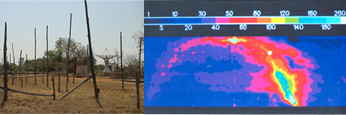
The array beams can be steered by appropriately phasing their elements. The beam of the N-S arm can be tilted within a declination range -45° to 75°. The beam of the E-W array can be tilted similarly in hour-angle within 10° around the meridian enabling tracking for a minimum of 42 minutes.
The mean sky brightness temperature at this frequency is about 10,000 K and so the minimum detectable flux density for a point source is about 10 Jy with an integration time of 10 s and a bandwidth of 200 kHz. This telescope has been used for continuum surveys of the accessible sky, studies of supernova remnants, giant HII regions, as well as of radio emissions from the undisturbed Sun and solar bursts. Using the tracking facility, observations of low-frequency radio recombination lines and emissions from many nearby pulsars have been made.