Scientists map the earliest glow of hydrogen, opening a new window to the universe
[Posted on 29 September 2026]
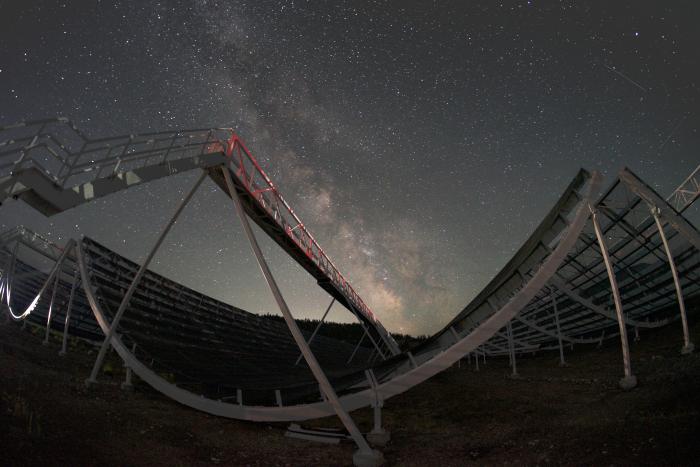
In an international collaboration that includes researchers from India, the Canadian Hydrogen Intensity Mapping Experiment telescope (CHIME telescope) has made its first standalone detection of the glow of hydrogen from when the universe was about five billion years old, paving the way for new studies of cosmic expansion and dark energy.
The CHIME interferometric radio telescope in Canada was built to map the distribution of hydrogen gas in the early universe, allowing astronomers to calculate its expansion and thus investigate dark energy, the mysterious force thought to be driving the universe to expand faster over time.
In a study that included CHIME collaborators at the Raman Research Institute (RRI), an autonomous institute of the Department of Science and Technology (DST), the CHIME telescope has shown, for the first time, that it can detect the faint glow of hydrogen gas from deep in the universe's past using only its own data.
The breakthrough paves the way for a faster, less expensive method for scientists to study dark energy — the mysterious force thought to be driving the universe to expand at an ever-increasing rate, and one of the biggest open questions in physics. The achievement also marks a milestone for the telescope, built for this very reason. The findings are published in a paper today in The Astrophysical Journal.
“Hydrogen is the most common element in the universe and the raw material from which stars form,” said co-author Dr. Arnab Chakraborty, postdoctoral fellow at the University of Toronto who first proposed the finding. “Its faint radio emission acts like a cosmic tracer, revealing how matter is distributed across space.”
There are contradicting theories about the nature of dark energy in the astrophysical community. Using its own data, CHIME can investigate these theories independently and help prove or disprove them.
“This is a completely new technique for probing the cosmos, delivered by an instrument that was conceived, built and funded by Canadians,” said co-author Dr. Mark Halpern, professor at the University of British Columbia and CHIME principal investigator.
“CHIME is a unique instrument that scans a large fraction of the cosmos as the sky drifts over it. With no moving parts and high accuracy measurements, CHIME delivers a snapshot of what our sky looks like at radio wavelengths every day!” added co-author Dr. Saurabh Singh, associate professor at RRI.
Previously, CHIME had to cross-correlate its observations with galaxy survey data from other telescopes. Galaxy surveys investigate the same question, using light and focusing in fine detail. They cost millions more dollars, and they focus just on the part of the universe hot and dense enough to form stars.
By mapping the combined radio glow that hydrogen emits on its own, CHIME can explore the same questions at a greater scale, further back in time, at a fraction of the cost and without relying on anyone else’s results.
In an accompanying paper, the researchers examined what the observed signal reveals about the distribution of hydrogen in the universe.
“Our data indicate that roughly two per cent of the hydrogen in the universe was in neutral atomic form at this time, broadly consistent with other measurements” said co-author Dr. Shabbir Shaikh, postdoctoral fellow at Arizona State University. “By measuring how that hydrogen is distributed and clustered, CHIME gives us a new way to test our understanding of how galaxies form and evolve”.
The finding wasn’t a Eureka moment. The research applied new data analysis and processing techniques to find the faint signal amongst the overwhelming noise of the background universe, human technology and even the instrument itself. They then spent more than a year testing the finding to prove it was correct: it was indeed a call from the universe itself when it was about five billion years old, based on 94 nights of observation data collected in 2019.
The current measurement uses only a small fraction of the data CHIME has collected since operations began. Researchers now have nearly seven years of observations available and are working to expand the analysis to include earlier periods in cosmic history when the universe was only three billion years old.