Scientists uncover a way to outsmart quantum entanglement loss with a single move
[Posted on 7 September 2026]

Article by Unnati Ashar
Illustrations by Arunima V
Video by Rahul Iyer
Timing is everything. Scientists have now devised a clever experiment that vindicates this wisdom. They found a way to preserve entanglement for an extended period by applying a well-timed flip operation, demonstrating that when to act is as important as what operation to apply in quantum systems. The trick could help fragile quantum links inside future quantum computers survive longer.
“To me, this is the heart of the result: timing is not just an experimental detail; it can be a control resource,” says Urbasi Sinha, group leader of the Quantum Information and Computing (QuIC) lab, which led the study, and senior professor at the Raman Research Institute (RRI), an autonomous institution of the Department of Science and Technology (DST). The study was partly funded by DST’s flagship National Quantum Mission.

Fig 1. A depiction of two entangled particles. An operation on one will affect the other in the same way even though they are in different environments.
Intertwined fates
Entanglement is a property that intertwines the state of one particle with another far-flung particle. Entanglement is a quintessential resource in quantum systems. However, entanglement can decay or weaken when it interacts with the environment.
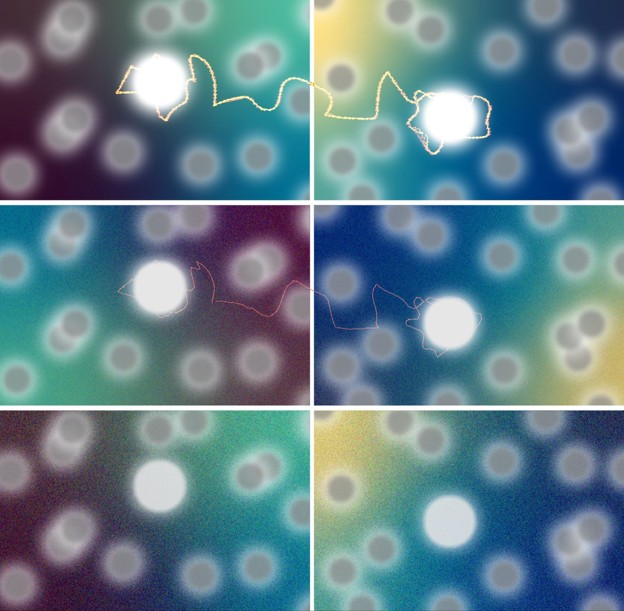
Fig 2. Entanglement can weaken or decay over time, due to noise in the environment, or just disappear suddenly.
Picture a pair of entangled particles, each of which can exist in two states — an excited state and a ground state. Left alone, each particle tends to decay from the excited to the ground state, much like an atom losing energy to its surroundings. As this happens, the entanglement between the pair weakens. Strikingly, entanglement can vanish at a finite time — well before the decay itself is complete. Physicists call this abrupt disappearance 'entanglement sudden death’. The aim of the team was to delay this death or avoid it altogether. The team consisted of scientists from RRI, the University of Calgary and the Louisiana State University. In fact, the work is the culmination of a long-standing collaboration between the QuIC lab and theoretical physicist A. R. P. Rau of Louisiana State University, with whom the group has been working on noise-related problems for several years.
The team came upon a clever setup to delay entanglement sudden death. They first mimicked the two-level system in their optical setup. Light has a property called polarisation that tells the orientation in which the light waves are oscillating. Assume the light or photons—the particles that make up light—exist in two different polarisation flavours- horizontal and vertical. They assumed vertical polarisation to be the excited state, and horizontal polarisation to be the ground state. To change polarisation, scientists use something called a waveplate. Using a waveplate, they could control the polarisation from vertical to horizontal, effectively controlling the decay of the particles to the ground state.
Just flip it!
Instead of allowing the excited state population’s natural decay to the ground state, they applied a well-timed operation using another waveplate that swapped the populations in the ground and excited states. The effect of this operation depended on when they applied it during the decay process. By choosing the timing, they delayed the decay of all particles to the ground state or delayed entanglement loss.
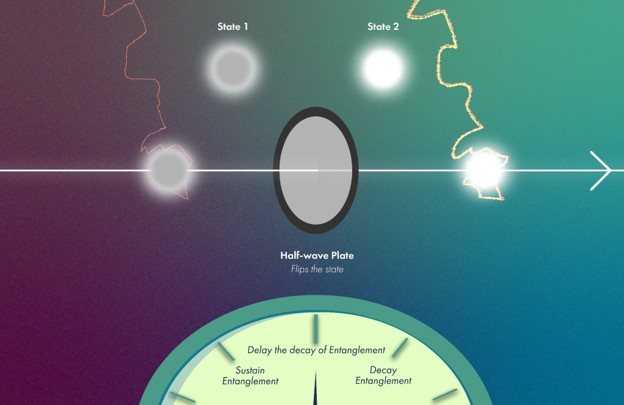
Fig 3. The placement of the operation can help control the decay of entanglement
A flip applied at the right moment doesn't just postpone the sudden death — it can prevent it from ever occurring. Theoretically, can entanglement survive forever? “Yes, that is what [we] call avoidance,” Kallol Sen, research associate at the QuIC lab, RRI, says.
“When you are applying, after how much of an evolution through the [decay], you’re applying this [single flip] operation will determine if you avoid or delay or hasten the sudden death,” says Saumya Ranjan Behera, a quantum scientist in the QuIC lab at RRI and the new study’s lead author. The paper was published in American Physical Society’s Physical Review A in July.
A lesson in perseverance
Optical experiments require intricate alignment and are complex by nature. This one, too, came with its own challenges. Midway through, the project hit a rough patch, and progress stalled. “For a while, it felt like the experiment had more ways of saying ‘no’ than we had ways of asking,” says Sinha. Sinha and Behera then rebuilt the understanding and pushed it forward. “That part of the story is very special to me, because the final result was … also a lesson in perseverance, patience, and belief in solid science.” The experiment, rooted in solid science, also finds potential applications in commercial quantum hardware of today and the future.
In quantum computers, which are a hotly followed topic these days, there’s a limit on how long quantum information can survive before it decays. “Our experiment shows that, in the presence of this kind of [limitation], the timing of an operation can change the fate of entanglement,” says Sinha.
A complication turns into the most interesting feature…
The QuIC lab is a classic example of theorists and experimentalists working in symphony. In this study, the experimental results came first. Now there are two standard textbook models of how quantum systems lose information to their environment. Surprisingly for the team, the experiment didn’t fall in either of those frameworks. The theorists then got to work.
“For almost a year, we explored different theoretical descriptions to understand the data. Eventually, we realised that the experiment was not ‘wrong’,” says Sinha.
They discovered that the experiment fell exactly on the curve that would join these two frameworks at the two ends. In essence, they found the ‘tuning parameter’ that would enable the experiment to slide between the two frameworks. So now there aren’t two separate setups for these two frameworks. This single setup can represent both the noise models and all variants in between, depending on the chosen tuning parameter.
“That was also one of the novelties of the theoretical part — that we managed to find this particular tuning parameter to move between these two extreme points connected by a curve,” Sen, a theorist, says.
“What first looked like an experimental complication became one of the most interesting features of the work,” says Sinha.
They’re now trying to model various kinds of noise in a single system, both theoretically and experimentally. “So I assume this will keep us occupied for some time,” Sen says.
Temporal steering of entanglement decay with single-shot control | Phys. Rev. A
Publication link: https://doi.org/10.1103/84n3-bcz8
Watch the SimplyPhy on the topic here: https://www.youtube.com/watch?v=HTd-diqSVKU
For more details, contact: outreach@rrimail.rri.res.in